
In 2005, a twenty-something engineer stood in front of an elephant pen at the San Diego Zoo and recorded an 18-second video titled “Me at the zoo.”
It was clumsy. Unedited. Utterly ordinary.
And it changed everything.
That upload, the first-ever YouTube video, became the accidental spark that set off a digital revolution. Within a few years, brands were swapping banner ads for video production.
By 2010, YouTube had crossed a billion daily views.
Today, video isn’t just one of many marketing channels. It is the channel.
The following video marketing statistics tell the story of how that transformation matured, who it has benefited, where the audience has shifted, and what the next era of content dominance looks like.
TL;DR — Key Video Marketing Insights from 2026
If you’re after the key statistics, here’s what the data says about video marketing in 2026:
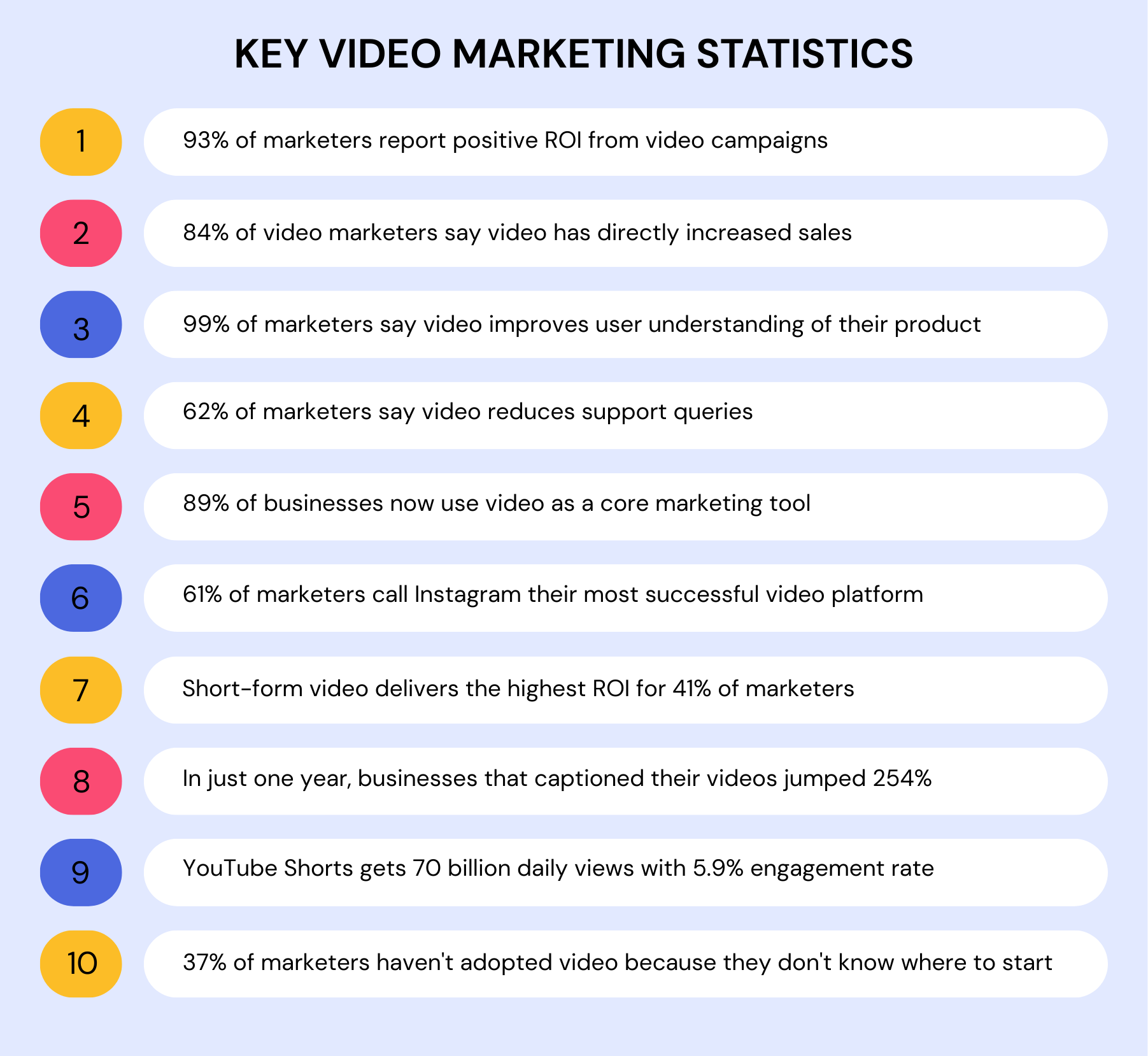
1. 93% of marketers report positive ROI from video campaigns.
2. 84% say video has directly increased sales.
3. 99% say video improves user understanding of their product.
4. 62% say video reduces support queries.
5. 89% of businesses now use video as a core marketing tool.
6. 61% of marketers call Instagram their most successful video platform.
7. Short-form video delivers the highest ROI for 41% of marketers.
8. In just one year, businesses that captioned their videos jumped 254%
9. YouTube Shorts gets 70B daily views with a 5.9% engagement rate.
10. 37% of marketers haven’t adopted video because they don’t know where to start.
Video Marketing Usage & Adoption
If your brand still isn’t using video, you’re no longer late; you’re officially behind.
The internet has evolved into a visual-first ecosystem where stories move, voices sell, and attention belongs to those who can hold it in motion.
This section breaks down who’s leading the video revolution, what’s keeping a few brands on the sidelines, and why this is the last year hesitation can pass as strategy.
1. 89% of businesses use video as a marketing tool (source)
If you’re in the remaining 11%, you’re either a rebel or trapped in a time capsule from 2008.
Video is everywhere, even in those “serious” B2B niches where the most action used to be a PDF getting downloaded.
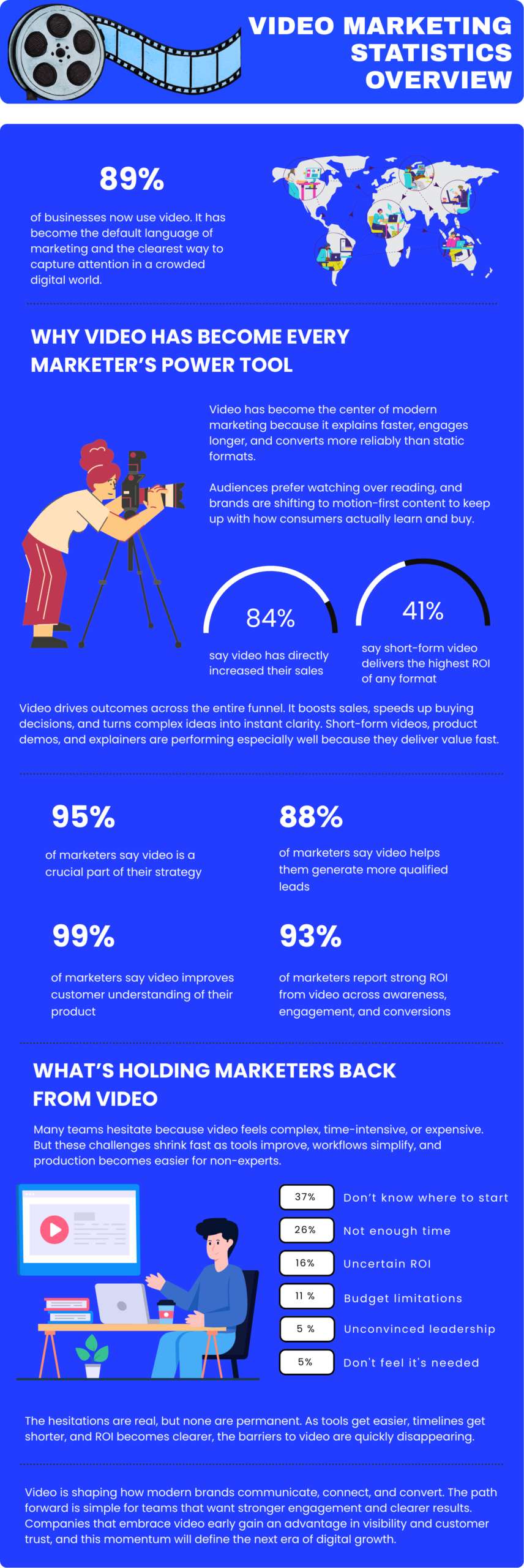
2. 95% of marketers say video is a crucial part of their strategy (source)
It now belongs on the mandatory checklist: right between “have a website” and “pretend to understand GA4.”
3. 99% of marketers say video improves user understanding of their product (source)

Translation: your explainer video is doing a better job than your sales deck ever did.
When people can see what you’re selling, they stop guessing what you mean and start asking where to buy.
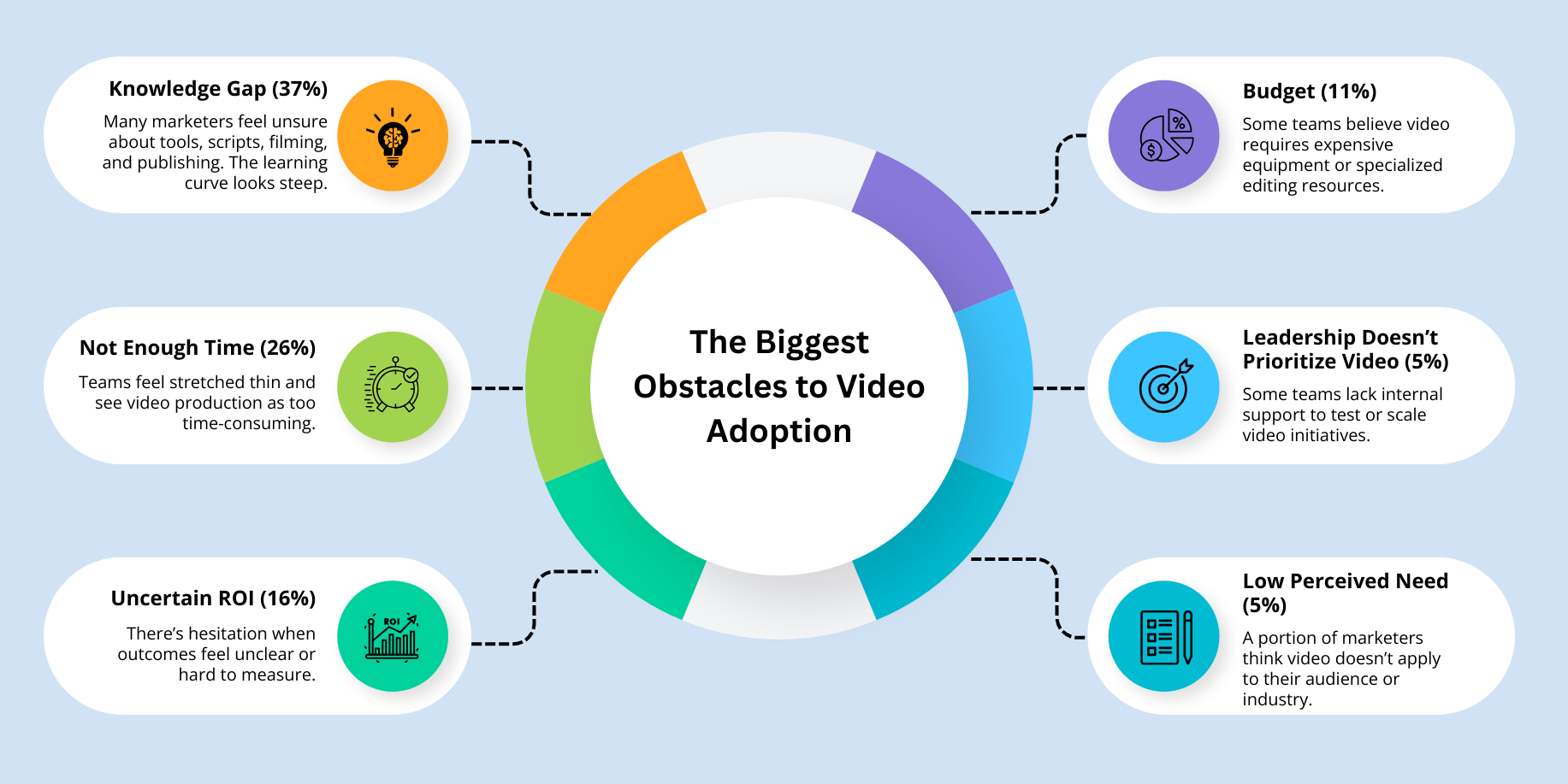
4. 37% of marketers say they haven’t adopted video because… they don’t know where to start (source)
Which is fair. Cameras are intimidating, editing is a time sink, and hitting publish feels like stepping on stage in front of your entire market.
But that knowledge gap is the single biggest blocker to video adoption, ranking higher than:
- Not enough time (26%)
- Uncertain ROI (16%)
- Budget limitations (11%)
- Unconvinced leadership (5%)
- The “we don’t need video” crowd (also 5%)
5. 65% of marketers who aren’t using video… plan to start this year (source)
If you’re still debating whether to hit “record,” just know the late adopters are finally suiting up and they’re bringing budgets, AI tools, and a backlog of ideas.
The advantage now belongs to those already publishing, testing, and refining.
The bottom line
Everyone’s doing video. Everyone’s planning to do more of it.
And if you’re not, your competitors will thank you for the free space on your customers’ feeds.
Video Marketing ROI & Performance

If marketing is about proving value, video has already won the argument.
Across industries, formats, and platforms, video continues to pull ahead with numbers that make decision-makers sit up straight.
1. 93% of marketers say video delivers strong ROI (source)
This is the highest figure Wyzowl has recorded since they began tracking. Video continues to prove its value by driving awareness, conversions, and qualified leads, often with results that make teams feel confident about their strategy.
It’s the rare marketing investment that actually pays off before your patience runs out.
2. 88% of marketers say video generates leads, and 86% say it increases web traffic (source)
Video has evolved into the new inbound engine.
Instead of chasing leads, marketers are now building pipelines with product walkthroughs, social content, and explainers that convert curiosity into clicks.
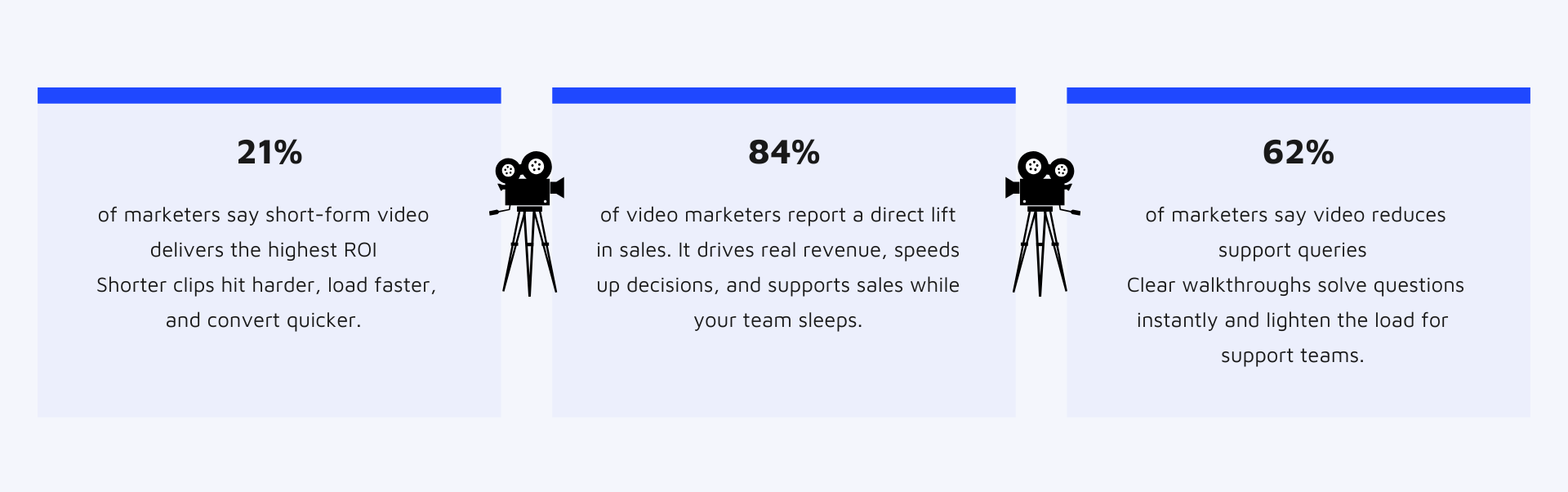
3. 21% of marketers say short-form video delivers the highest ROI (source)
In case it wasn’t obvious: shorter is better.
4. 84% of video marketers say video has directly increased sales (source)
Read that again. Not inspired awareness. Not improved engagement. Sales.
Video has gone from the creative department’s toy to the sales team’s secret weapon, the kind that closes deals while your SDR is still “circling back.”
5. 62% of marketers say video reduces support queries (source)
That’s right, video even saves your support team’s sanity.
Explainer videos, onboarding tutorials, and “how it works” clips are quietly cutting ticket volumes and improving user satisfaction.
6. 36% of marketers believe video costs are falling, while 28% say they’re rising (source)
The verdict? It depends on who you ask and how they’re creating.
With AI tools, in-house workflows, and streamlined template editing, more marketers are showing that ROI is driven by consistent output and strategic relevance rather than expensive production setups.
7. Businesses with in-house video creators report higher ROI (source)
The payoff for keeping production internal is clear: higher returns, faster turnarounds, and fewer bottlenecks.
When creative control lives down the hall instead of in another time zone, content moves at the speed of relevance.
8. 66% of video marketers measure ROI through engagement metrics (source)
Likes, shares, and reposts still dominate the ROI conversation, but that’s shifting.
62% now track video views, 49% measure leads or clicks, and 30% tie performance directly to sales.
The best teams blend metrics because the full story rarely fits in one data point.
9. 25% of marketers spend $1K–$5K per marketing video (source)
Production budgets are stabilizing between DIY efficiency and professional impact.
Only 4% cross the $20K mark, proof that good storytelling doesn’t require blockbuster spend.
Great lighting helps, though.
10. Product videos deliver the strongest ROI for 66% of marketers (source)
Demonstrating what your product does beats describing it every time.
Product videos continue to outperform all other formats for ROI, engagement, and lead generation.
11. Videos between 30 seconds and 2 minutes are the sweet spot for effectiveness (source)
This window hits the goldilocks zone: long enough to make a point, short enough to keep thumbs from twitching.
12. 92% of companies are satisfied with the ROI from their video marketing efforts (source)
The consensus is clear: video isn’t a gamble anymore.
It’s the one marketing channel where satisfaction (and spend) are moving in the same direction.
Video is boosting sales, generating leads, cutting support costs, and doing it all on leaner budgets.
The bottom line
The numbers around video performance are consistently strong. Marketers see clear gains in leads, traffic, sales, and even support reduction when they invest in the right formats.
For many organizations, video has become one of the most dependable ways to turn attention into revenue.
Video Creation & Production Trends
The cameras are rolling everywhere, from boardrooms to breakrooms, from tripods to trembling hands.
Video creation has officially gone democratic. It’s no longer the domain of agencies with lighting rings. It’s an in-house muscle powered by caffeine, Canva, and increasingly, AI.
In 2026, the line between creator and marketer has blurred beyond recognition. Here’s what that new reality looks like in data.
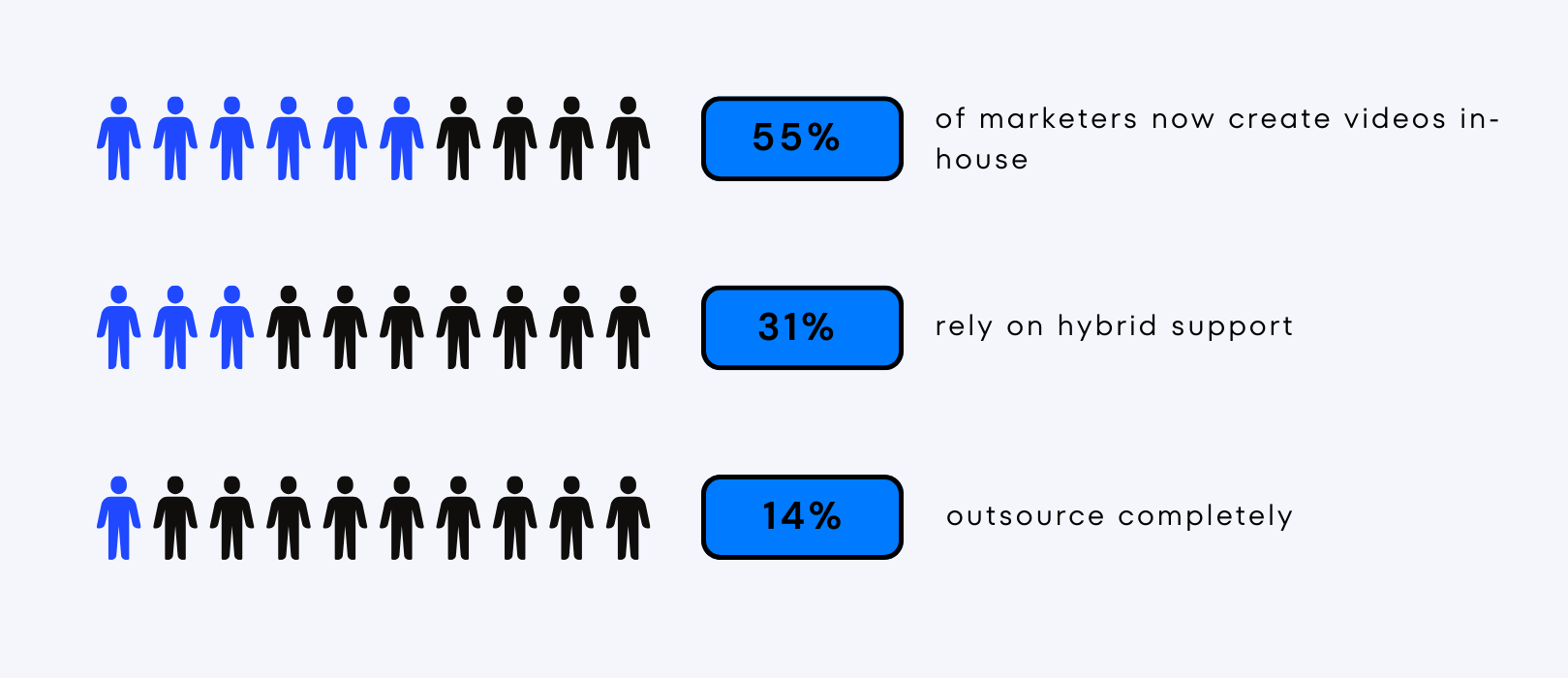
1. 55% of marketers produce videos in-house (source)
Companies are done outsourcing every clip to agencies.
Most brands now have someone who “just kind of does video now,” also known as the multitasking marketer who somehow films, edits, scripts, and cries during post-production.
Another 31% use a mix of freelancers and vendors, while only 14% fully outsource.
2. Most companies create live-action videos (source)
54% of marketers are hitting “record” on their cameras (or phones) for everything from product demos to customer testimonials. Animated video clocks in at 24%, with screen-recorded content trailing at 15%.
3. Last year, 75% of marketers used AI for video. This year, that dropped to 51%. (source)
Why? Because AI videos still occasionally look like fever dreams.
Apparently, marketers realized they’d rather deal with human error than watch a deepfake sales rep wink at the wrong camera.
The opportunity? Use AI for speed, not substitution. People still connect to people.
4. In just one year, businesses that captioned their videos jumped 254%. (source)
Accessibility is trending, not as a moral checkbox, but because silent scrolling is the new normal.
Auto-captioning has become table stakes, helping brands reach wider audiences (and score SEO points along the way).
If your video doesn’t have captions, it’s invisible to the subway commuter, the bored employee, and the toddler mom on 1% volume.
5. 61% of marketers say time and bandwidth are their biggest production hurdles (source)
Not budget. Not talent. Just time.
Teams are juggling “create more video” mandates with the same 24 hours everyone else gets.
That’s why short-form and repurposed content are exploding because quantity isn’t killing quality anymore, velocity is.
6. 53% of marketers allocate one-third (or less) of their budget to video (source)
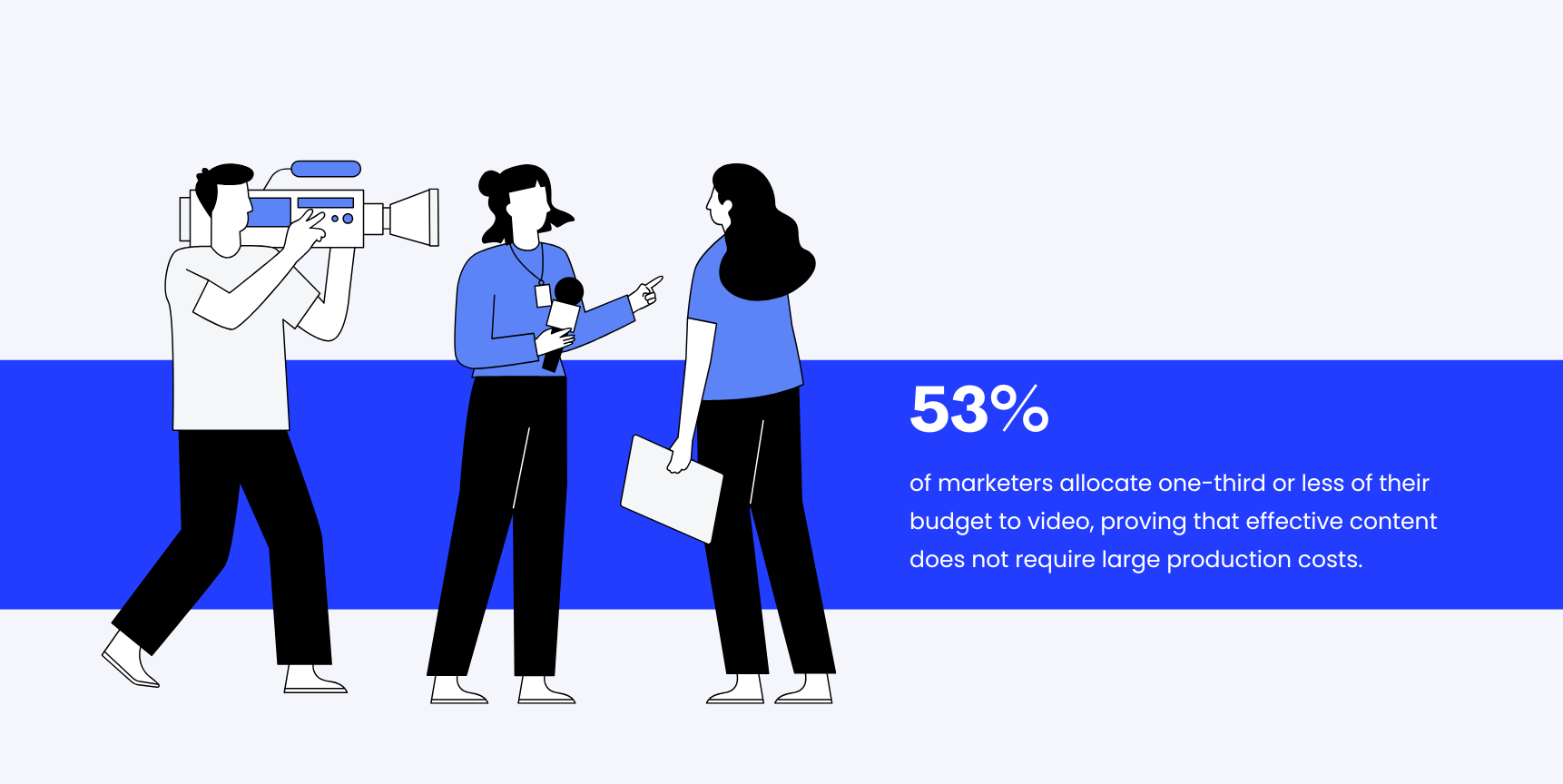
Not everything needs a $10K production budget. Many brands are getting by with Canva, CapCut, and caffeine.
However, 14% of marketers have no clear record of their video spend, which is a remarkably daring approach to budgeting.
7. Interactive, 360°, and VR videos remain under 20% effective (source)
The “future of video” is still stuck in beta.
VR, 360°, and interactive formats look flashy in pitch decks but underperform in practice.
Until audiences can consume them without nausea or goggles, they’ll probably still be the “future of video” for some time.
The bottom line
Video creation now lives much closer to the marketing team than it used to.
More brands are producing content in-house, using simple tools, AI support, and lean workflows to keep up with demand.
Video Marketing Content Types

Not all videos are created equal. Some sell, some teach, and some just look great in your campaign recap deck.
In 2026, the data shows a clear pattern: utility beats aesthetics.
The videos winning attention, engagement, and conversions are the ones that do something like explain, prove, or guide.
Here’s what’s dominating the content mix this year:
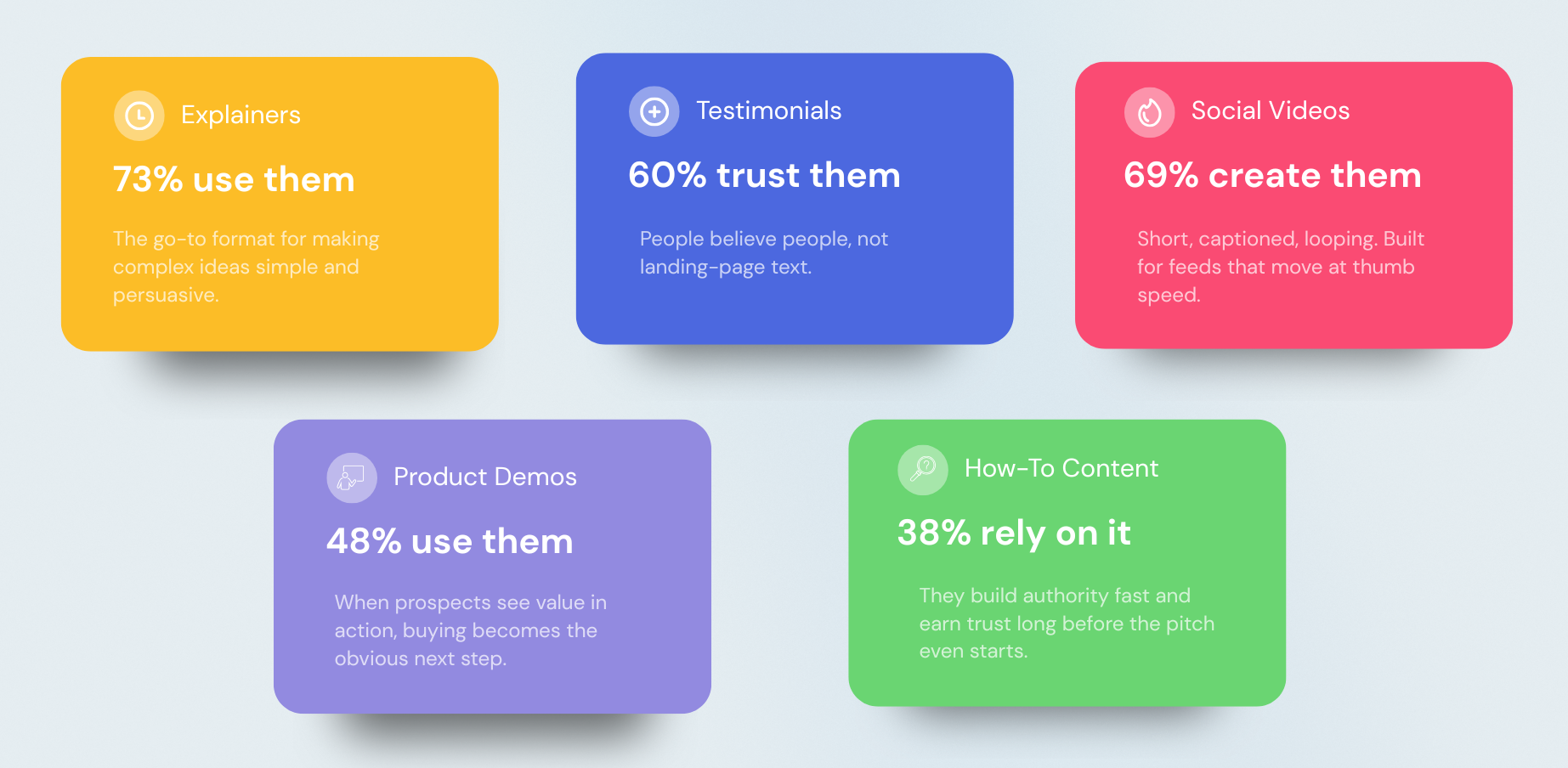
1. 73% of marketers create explainer videos (source)
Explainer videos are simple, powerful, and usually easy to digest.
They’re how brands simplify complex ideas, convert leads, and give their customers that “ohhh, now I get it” moment.
2. 69% of marketers are creating social media videos (source)
Brands are pushing out quick, lightweight videos built for nonstop feeds. These clips are designed to load fast, work without sound, and fit the vertical swipe habits that dominate today’s platforms.
Short-form video has become the primary way people discover and consume content online, so teams are investing heavily in formats that match how users actually scroll.
3. Video testimonials are trusted by 60% of marketers (source)
Testimonial videos turn happy customers into your most persuasive sales team.
42% of viewers say they trust these more than any other marketing format because people believe people, not polished copy.
If your clients are singing your praises in text, imagine the conversion power when they’re saying it on camera.
4. 48% of marketers use product demo videos (source)
Show > tell.
Product demos pull prospects over the line by making features tangible and value obvious.
69% of consumers say demos directly influence their purchase decision.
5. 38% of marketers rely on how-to and educational videos (source)
Teach first, sell later.
How-to videos drive some of the highest engagement in the game. Viewers watch 74% of them to completion.
They build authority, loyalty, and trust, three things no ad budget can buy.
6. Culture videos are quietly redefining employer branding (source)
From hiring to retention, culture content is having a moment.
Behind-the-scenes clips, team stories, and leadership insights show what the brand feels like, not just what it sells.
The bottom line
The strongest video formats are the ones that help people understand, decide, and act.
Explainers, social clips, product demos, testimonials, and how-to content all earn attention because they answer real questions and show real results.
Video Distribution & Channel Trends

Video platforms are more than distribution points. They operate as full ecosystems.
Each one has its own algorithmic mood swings, unspoken etiquette, and native species of content creator.
Here’s how the marketing world’s attention is being sliced, diced, and streamed.
1. YouTube: The undisputed heavyweight
YouTube remains the #1 most used and most effective video marketing channel with a 90% adoption rate in 2024.
Even with TikTok stealing the “scroll fix,” YouTube keeps winning on both reach and longevity.
Why? Because YouTube plays the long game.
While other platforms burn fast and fade, YouTube videos accrue views, backlinks, authority, and sales for years.
YouTube behaves more like a searchable library than a feed. Content stays discoverable, keeps getting recommended, and continues driving traffic long after upload.
2. Instagram: the engagement engine
61% of marketers call Instagram their most successful video platform.
Reels, Stories, and Lives continue to dominate, with 67% of marketers planning to increase their investment in Instagram video this year.
Short-form video drives most of the momentum on Instagram, and brands that lean into it usually stay ahead.
3. LinkedIn: The B2B dark horse turned content powerhouse
LinkedIn has gone from résumé dump to one of the most-watched stages in B2B marketing.
70% of marketers now post videos here, officially dethroning Facebook for professional attention.
And they’re not polished productions: 97% are vertical, 78% shot on smartphones.
Professional now means relatable enough to trust, not perfectly produced.
4. TikTok: Conversion at the speed of scroll
TikTok’s influence is still expanding. 27.6% of marketers are upping their spend here this year.
And videos with captions on TikTok see a 95% boost in brand affinity and a 25% jump in uniqueness.
It’s the most chaotic lab in marketing, but the experiments often work.
5. YouTube Shorts: Alphabet’s revenge play
- 70 billion+ daily views
- 2 billion monthly viewers
- 70% of YouTube creators upload Shorts monthly
- 5.9% engagement rate, the highest among short-form platforms
Shorts have quietly become YouTube’s revenge against TikTok, and marketers are shifting ad dollars accordingly. Alphabet says ad monetization on Shorts has more than doubled in the past 12 months.
6. Facebook: still alive, somehow
66% of marketers use Facebook for video marketing, but it’s not the powerhouse it once was.
It’s still solid for community-based content, brand storytelling, and your aunt’s favorite recipes, but the younger crowd has moved on to flashier feeds.
7. Webinars & Live Streams: the long-form dark horse
Webinars are the second most impactful video type, with nearly 50% of companies hosting them regularly.
Even better: 40% of webinar views happen on-demand, proving that “live” content can live forever (and keep converting long after you’ve stopped talking).
Zoom still rules the space, but embedding replays on blogs or landing pages gives them a second life and a second round of backlinks.
8. Owned Channels: Your most underrated platform
Despite the social frenzy, 67% of companies host videos on their website, and 49% share via email.
It’s a classic play that still works: no algorithm, no distractions, just your message, directly on your turf.
The bottom line
YouTube builds reach. LinkedIn builds credibility. TikTok builds connections. Instagram builds engagement. Your website builds conversions.
The brands winning now know exactly which one to prioritize and when to scroll past the noise.
The Future of Video Marketing in 2026 (and Beyond)
The data tells a clear story. Video has moved from a high-impact format to a default expectation, and the way marketers use it is becoming more structured and more practical. Teams are prioritizing formats that solve real problems, answer real questions, and support real buying decisions.
Three shifts stand out when looking at how companies are planning for 2026.
- First, utility is becoming the anchor. Explainers, demos, tutorials, and customer stories consistently outperform polished brand pieces because they help viewers understand products faster. The strongest performers in this report are the formats that reduce friction for prospects and customers.
- Second, production is getting faster and more internal. Most teams are no longer waiting on agencies for every edit or storyboard. They are filming in-house, refining quick workflows, and focusing on steady output instead of one-off “big” videos. This is creating more experimentation and more data to guide future decisions.
- Third, distribution strategies are maturing. YouTube remains the most dependable source of sustained visibility. Instagram and TikTok reward quick, lightweight storytelling. LinkedIn has become a reliable stage for B2B videos. Company websites and email continue to convert quietly but effectively. The strongest results come from matching the format to the channel instead of treating every platform the same.
Overall, video in 2026 is entering a more mature and data-aware stage. Brands that build steady workflows, invest in clarity, and stay close to audience behavior will see the strongest returns. The opportunities remain wide, and the demand for helpful, high-quality video continues to grow.

- 80+ Eye-opening SEO Statistics for 2026 - February 24, 2026
- 70+ Important U.S Small Business Statistics [2026] - June 7, 2026
- 80+ Revealing Remote Work Statistics & Trends [2026] - February 20, 2026
Get more traffic, get more conversions – all without paying for ads 

Let’s chat to see if we can help you multiply your SEO revenue.
Get more traffic, get more conversions – all without paying for ads
Let’s chat to see if we can help you multiply your SEO revenue.
