
The world of organic search has never been this CRAZY.
According to Google, sending traffic to websites is a “necessary evil” (this is what their head of search actually said).
The actions of the internet’s greatest gatekeeper have largely reflected this sentiment, as AI Overviews continue to erode clicks, attribution becomes almost impossible, and competition authorities look to force Google to make changes that actually benefit the consumer.
All of this in the backdrop of the seismic shift that is AI search.
We’ve never seen this level of ecosystem disruption or pace of change.
The ominous part?
We’re only at the start of this full-throttle acceleration to an AI-driven world.
The following eye-opening SEO statistics expose the new dynamics of search and lay out the stark choices for anyone looking to be seen, heard, and chosen.
TL;DR — Key SEO Insights & trends for 2026
If you want the fast version of where search is heading, here are the forces reshaping visibility in the AI era:
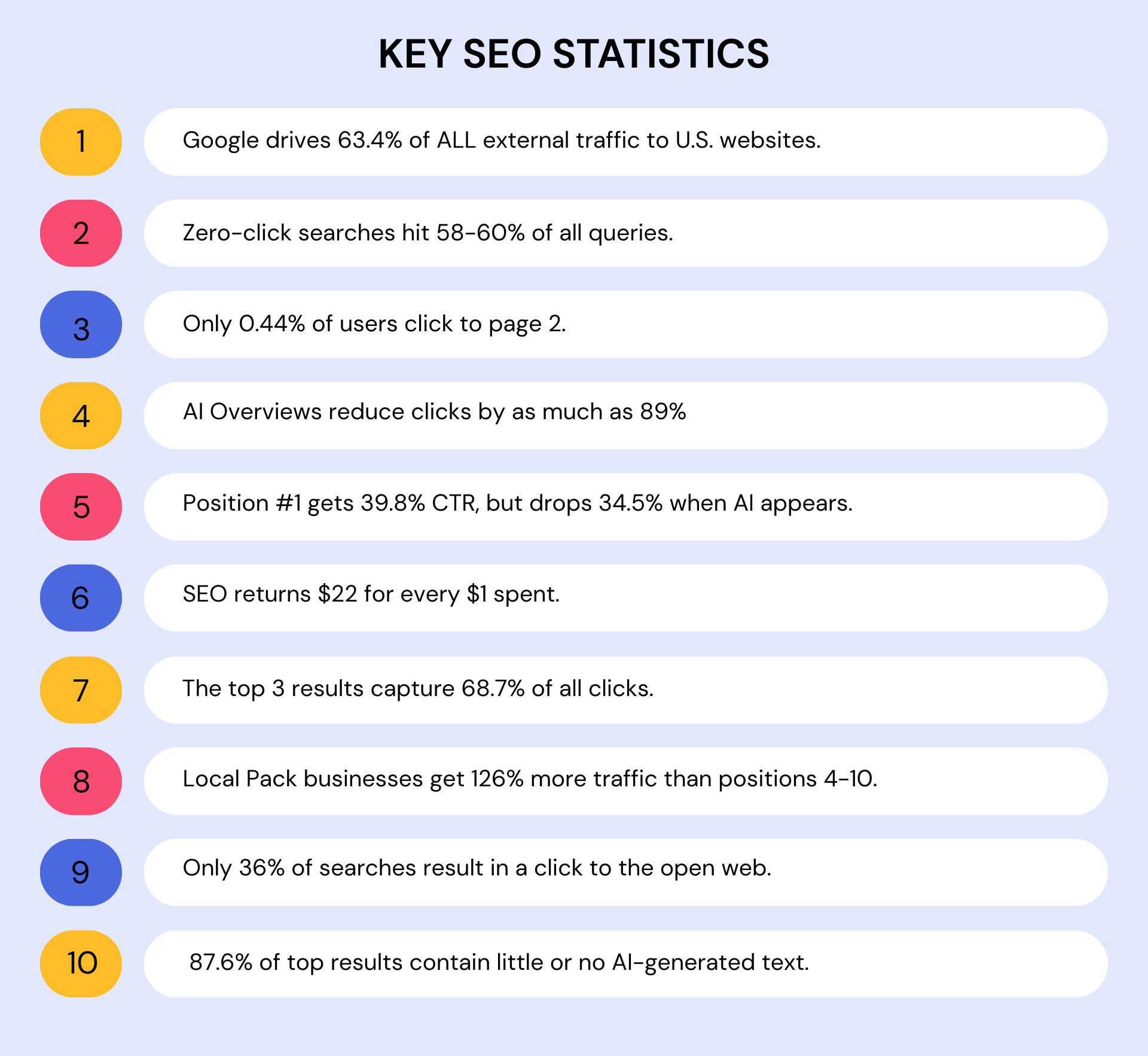
1. Zero-click searches hit 58-60% of all queries.
2. Only 0.44% of users click to page 2.
3. Google drives 63.4% of ALL external traffic to U.S. websites.
4. AI Overviews reduce clicks by as much as 89%
5. Position #1 gets 39.8% CTR, but drops 34.5% when AI appears.
6. SEO returns $22 for every $1 spent.
7. The top 3 results capture 68.7% of all clicks.
8. Local Pack businesses get 126% more traffic than positions 4-10.
9. Only 36% of searches result in a click to the open web.
10. 87.6% of top results contain little or no AI-generated text.
The State of Search in 2026: Google’s Undisputed Reign
If search were a sport, Google would be the only team on the field while everyone else fights over who gets a seat on the bench.
Its market share gives it unmatched influence over how information is discovered, how traffic flows, and which businesses gain visibility.
The scale of that reach shapes the rules of modern search and the realities every SEO operates within.
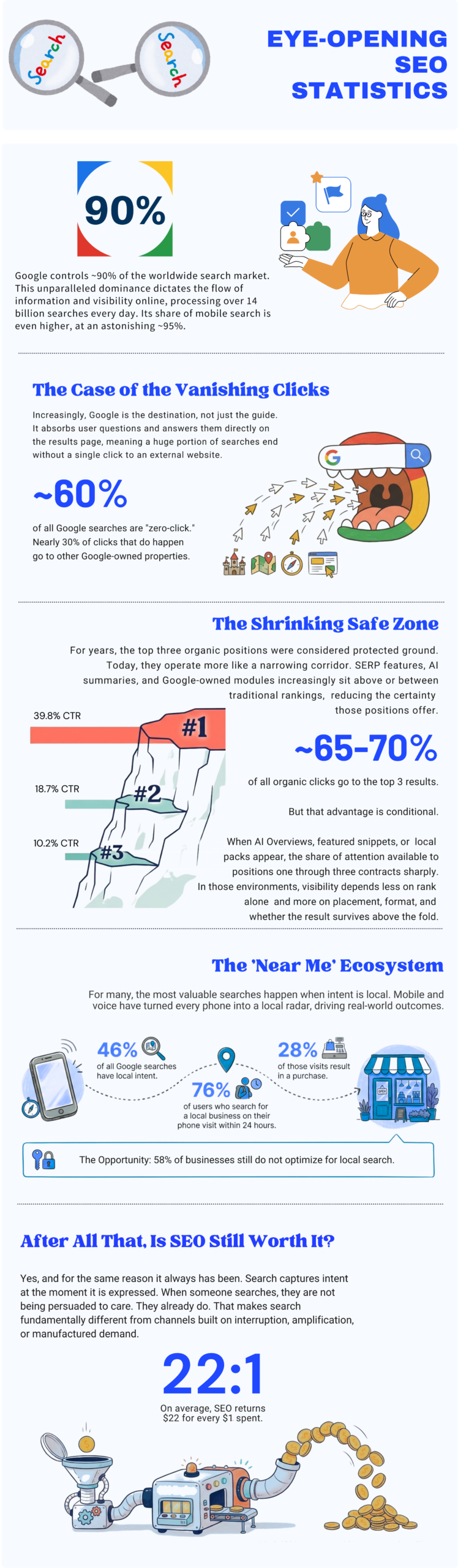
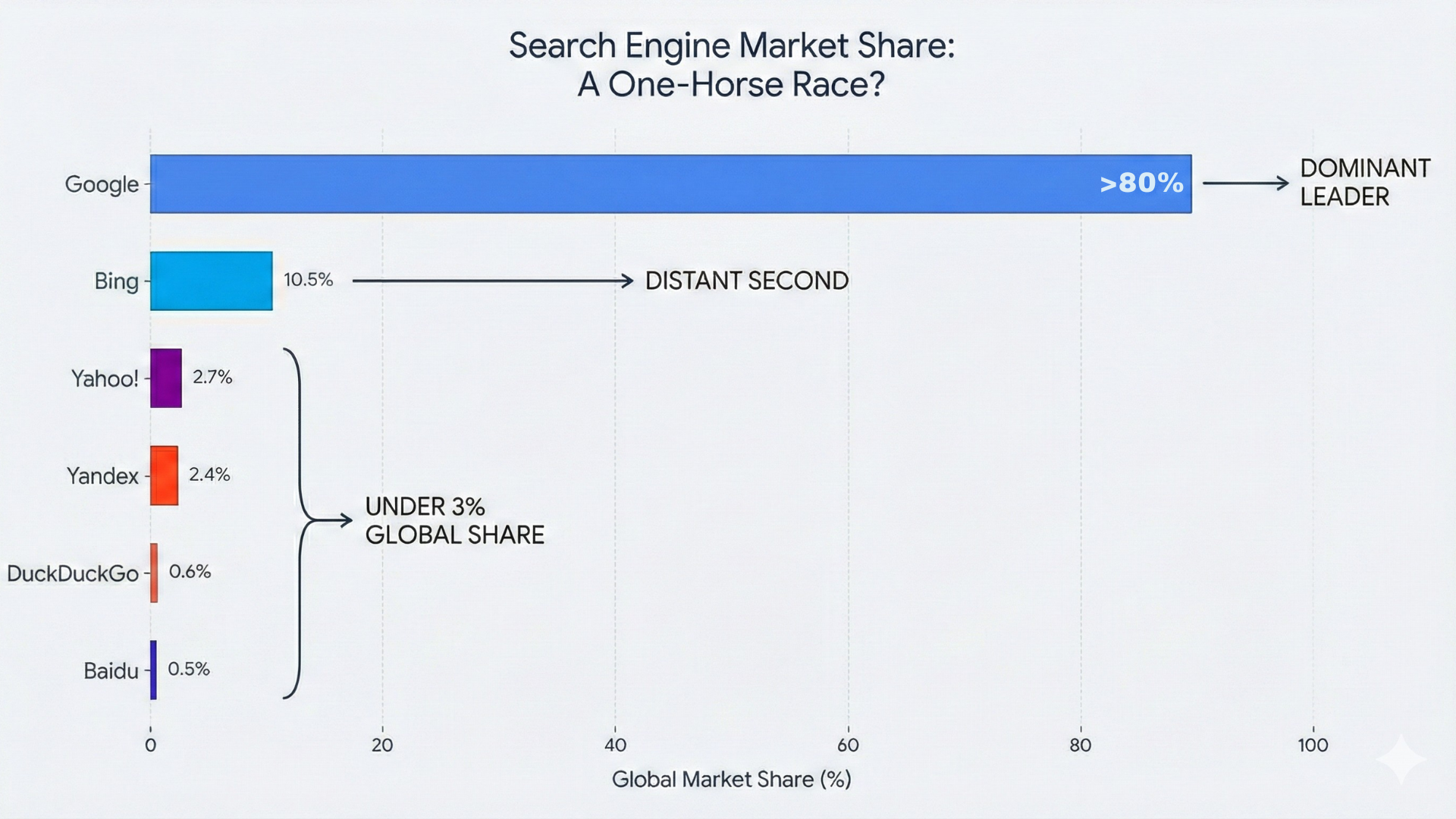
1. Google controls roughly 89–90% of the worldwide search market share (source)
Google’s share briefly slipped under 90% for the first time since 2015, then snapped right back, proving that even its “declines” are statistical rounding errors.
No other platform dictates global discovery at this scale.
2. Google holds about 83% of desktop searches globally (source)
Desktop is the one arena where competitors have slightly more room to breathe, yet Google still commands more than four out of every five searches.
3. Google owns an astonishing ~95% of global mobile search share (source)
Virtually every tap, swipe, and click funnels through Google’s index, leaving competitors to fight over single-digit leftovers.
4. Over 1 billion people use Google search services (source)
Google’s user base is essentially the online population, meaning every SEO decision is a bet on how Google interprets the internet.
5. Google now processes more than 5 trillion searches per year (source)
That breaks down to 14 billion searches a day, or 158,000 every second.
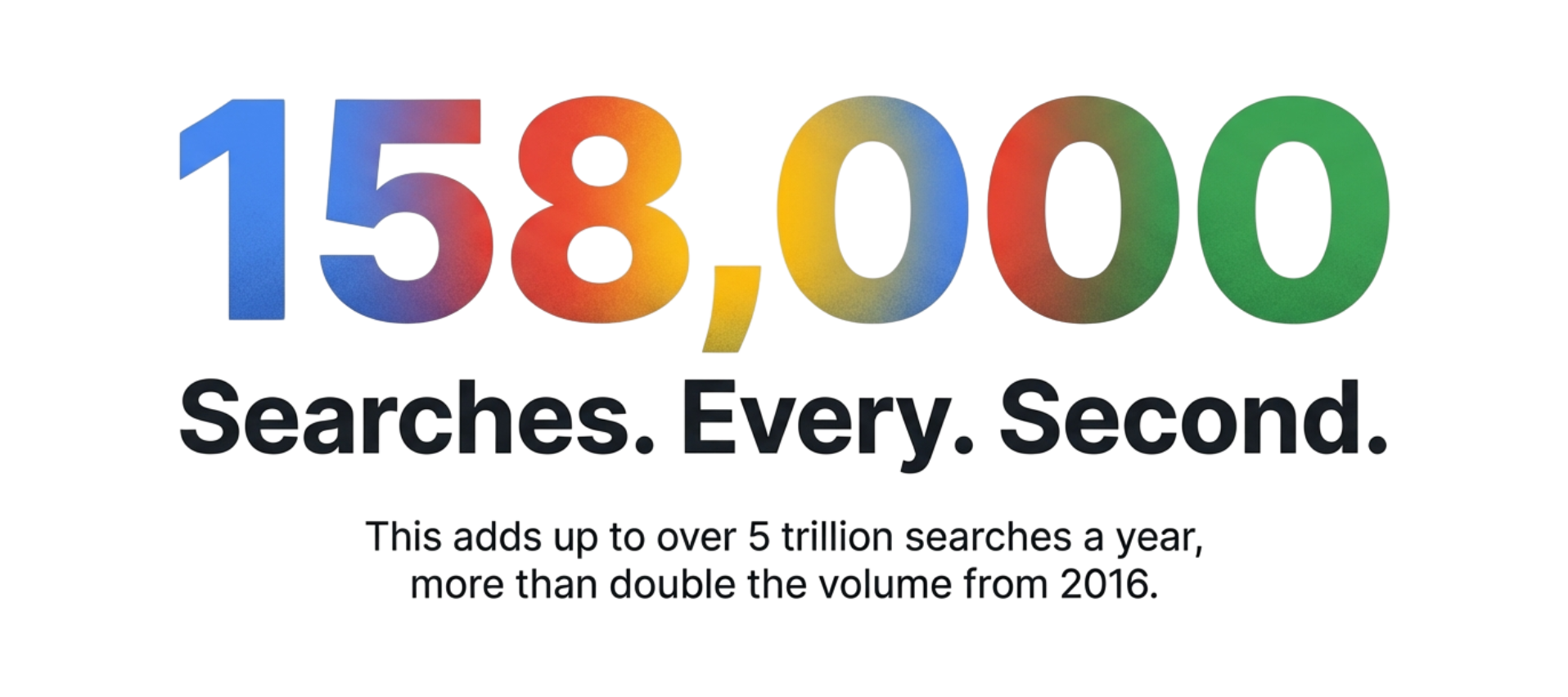
Matched against Google’s last official number of 2 trillion in 2016, the trend line is unmistakable.
6. Query volume grew about 21 to 22 percent year-over-year from 2023 to 2024 (source)
Instead of flattening, Google is absorbing more of the internet’s daily curiosity and widening the gap between itself and every competitor trying to stay visible. However, they have achieved this by verifiably degrading the search experience for users globally.
7. Google.com accounts for 63.4% of all external traffic to websites in the U.S. (source)
No other domain comes close. Google drives 10× more traffic than the next biggest referrer.
If a website grows, it’s usually because Google sent the visitors.
8. Competitor Comparison
Bing: ~10.5% of global share (source)
Bing is the runner-up, though calling it a “runner” is generous.
Yahoo: ~2.7%
Yandex: ~2.4%
DuckDuckGo: ~0.6%
Baidu: ~0.5% (source)
None of them cracks even 3% globally. For anyone tracking market power, the picture is clear. Google sets the pace, and the rest of the field follows it.
9. Google handles 210x more daily queries than ChatGPT (source)
AI chat tools are growing rapidly, but search remains the primary gateway to information for most people.
Bottom line
The uncomfortable truth is that most sites do not grow because they earned attention independently. They grow because Google allowed it. When that allowance shrinks, so does traffic, regardless of effort or quality.
Search is still the primary gateway to the internet. It just happens to be owned, shaped, and throttled by one gatekeeper.
The High Stakes of Ranking: CTR and User Behavior
Let’s be blunt:
Google is still the biggest referrer on the planet… and it’s actively trying to refer less.
Your rankings might look “fine,” your impressions might climb, and yet your traffic can still flatline because the SERP is now designed to finish the search without you.
And if you’re wondering whether “ranking #1” still matters:
Yes. But the way it matters has changed.
In a lot of SERPs, #1 is competing with Google’s own interfaces (AI Overviews, Featured Snippets, PAA, video blocks, local packs, shopping units, “things to know,” and more).
1. 39.8% CTR for the #1 organic result (source)
The top organic result captures a disproportionate share of clicks. Many users choose it because it appears to be the most direct, credible answer, and they often click without comparing multiple options.
2. 18.7% CTR for #2 and 10.2% for #3 (source)
The intent signal weakens fast once you are no longer first. Users still click, but with less certainty and less urgency.
By the time you reach third, you are already competing with distractions rather than leading the decision.
3. Positions #4–#10 fall into single digits, and the bottom of page one sits under 2% CTR (source)
Being on page one absolutely matters. It means you are visible, relevant, and in the consideration set.
At the same time, traffic becomes more uneven as you move down the page. Users scroll, scan, and compare, which makes clicks less predictable.
Results in this range often benefit from strong intent matching and compelling snippets rather than pure rank alone.
4. The top three organic results collect about 68.7% of all clicks on the page (source)
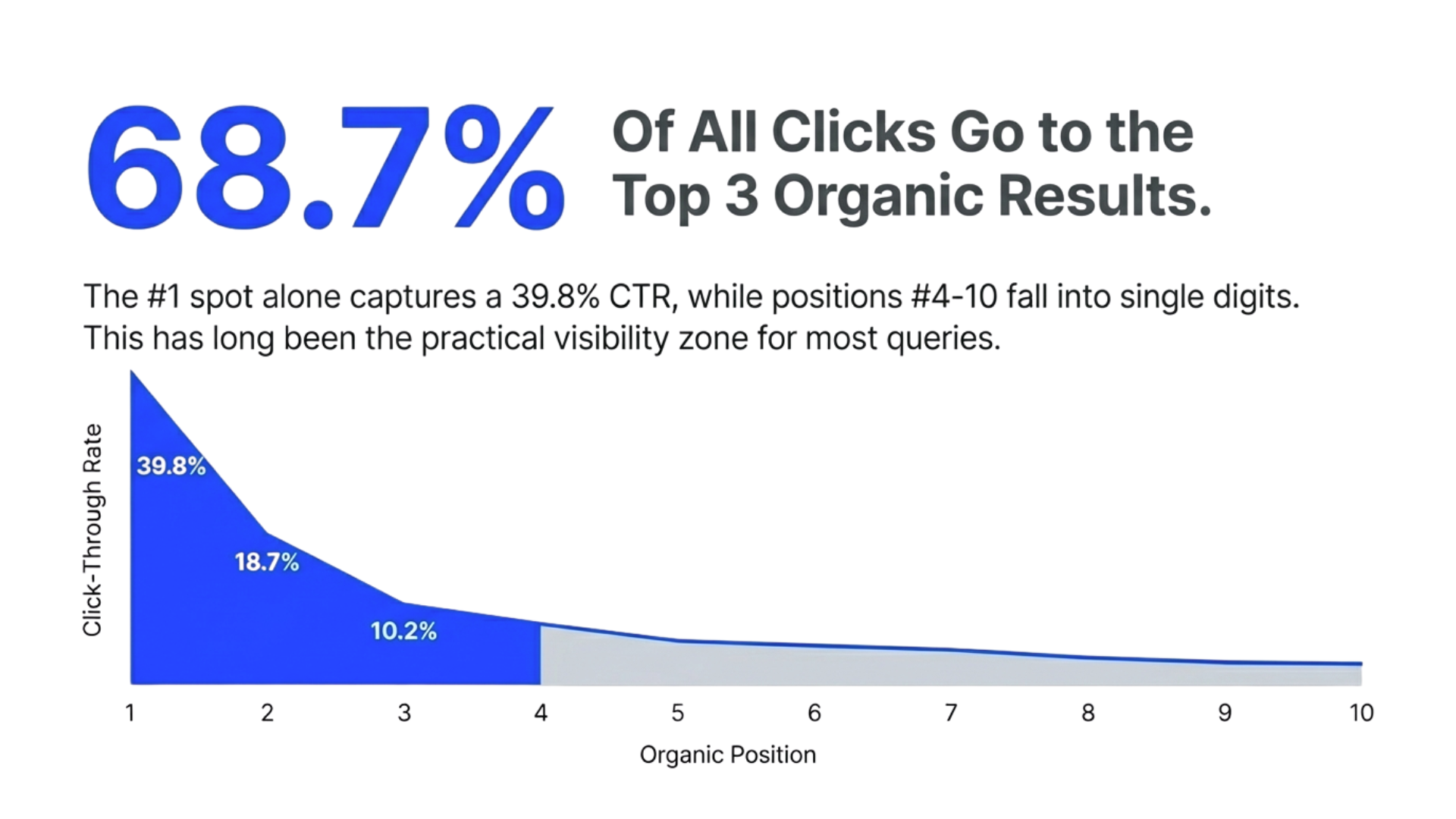
This is the practical boundary of visibility. Above it, traffic is real and measurable. Below it, presence is mostly symbolic.
Being on page one still matters, but being in the top three is what determines whether a page actually gets used.
User Behavior: Scrolling, SERP interaction, zero-click patterns
5. Only 9% of users scroll to the bottom of page one (source)
The modern searcher is impatient and trained to trust the top.
If you rank near the bottom, you are relying on users who are willing to keep looking after deciding the first results were not good enough.
6. Only 0.44% click to page two (source)
Page two attracts fewer visitors than some abandoned social platforms.
In fact, surveys estimate that around 75% of users never venture beyond page one.
7. Zero-click searches account for 58–60% of all queries (source)
Nearly 60 percent of users stop the moment Google gives them something that feels good enough.
They never reach the page that did the real work, which turns hard-earned rankings into hollow victories. Visibility no longer guarantees a visit.
8. Nearly 30% of clicks go to Google-owned properties (source)
The house is dealing the cards and also taking home the winnings. Users think they are exploring the internet, but most of the time, they are wandering through rooms Google built for them.
9. Only about 36% of searches result in a click to the open web (source)
A shrinking share of searches reaches independent websites.
This is what happens when answers appear earlier in the journey and when users accept those answers without additional verification.
Content creators must adjust their strategies to match a world where visibility is not the same as a visit.
Organic vs paid CTR differences
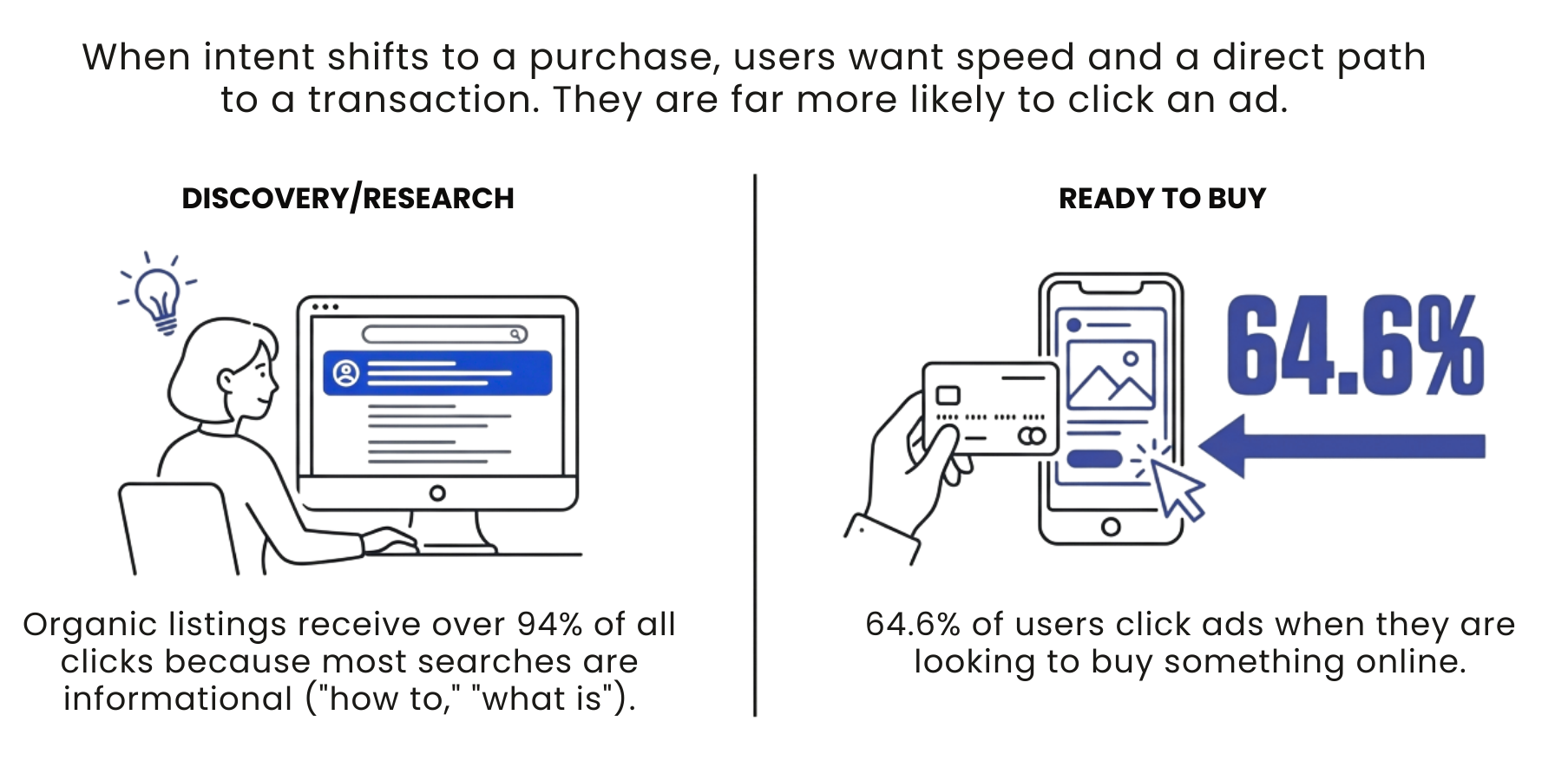
10. Organic listings receive more than 94% of all clicks (source)
This number sounds decisive, but it does not tell the full story. It blends every type of search into one measurement, including informational queries where ads are irrelevant, and users would never click a sponsored result anyway.
When you include definitions, how-to searches, navigational brand lookups, and general curiosity queries, organic wins by default. It has nothing to do with ads underperforming and everything to do with intent.
11. 64.6% of users click ads when they are looking to buy something online (source)
Commercial intent tells a very different story. When users arrive with the intention to purchase, they are far more likely to click an ad because they want speed, clarity, and a direct path to a transaction.
This is the traffic that matters most for businesses, and it behaves very differently from the broader search population.
Organic dominates discovery. Paid dominates buying moments.
12. Factoring all types of searches, the top organic result receives about 19 times more clicks than the top ad (source)
This ratio reflects how people behave when they have no buying agenda. Most searches start as quick checks or curiosity dives, and users instinctively reach for the first organic result because it feels earned.
This does not mean ads struggle. It means the majority of queries are not commercial to begin with.
13. The top ad spot averages around 2% CTR across the full search landscape (source)
This number is low because it includes millions of searches where advertising is irrelevant.
Users do not click ads for definitions, troubleshooting, or general research. When the intent shifts toward a purchase, this percentage looks completely different.
Ads perform when money is on the table, and the user has already decided the next step.
14. In 2024, the average click-through rate (CTR) for Google Ads was 6.42% (source)
A CTR above six percent shows how well paid search performs when users arrive with real intent. People click ads when they already know what they want and want to get there quickly.
This is the role PPC plays for most brands. It steps in at the moment where organic visibility has already shaped awareness and trust.
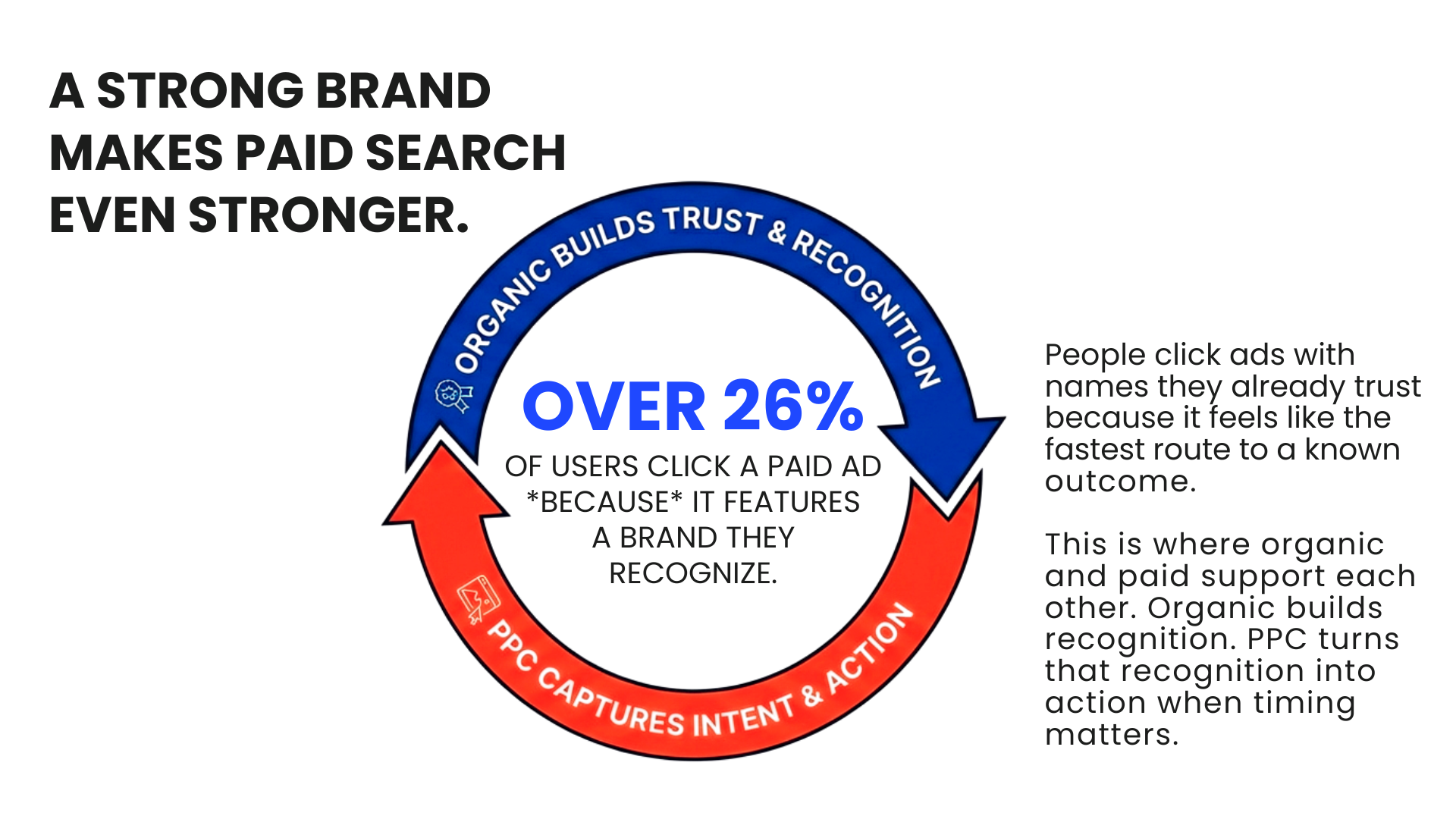
15. Over 26% of users click a paid ad because it features a brand they recognize (source)
Brand familiarity drives more paid engagement than most teams realize.
People click ads with names they already trust because it feels like the fastest route to a known outcome. This is where organic and PPC support each other.
Organic builds recognition. PPC turns that recognition into action when timing matters.
Mobile vs desktop search behavior
16. CTR is declining on both mobile and desktop (source)
Users are clicking less because Google keeps handing them answers before they even think about visiting a site.
People see a summary, glance at a widget, read a snippet, and feel like the job is done.
17. Desktop users click faster: 45% click within 5 seconds vs. 33% on mobile (source)
Desktop users tend to click sooner because more results are visible at once, and it’s easier to scan the page. Mobile users often take longer because the interface requires more scrolling and comparison before selecting a result.
The difference is largely driven by browsing context and screen constraints, not lower intent.
Impact of AI overviews on user behavior
18. When an AI summary appears, users click significantly fewer standard results. Organic clicks fall to about 8% on these pages, compared to 15% without AI (source)
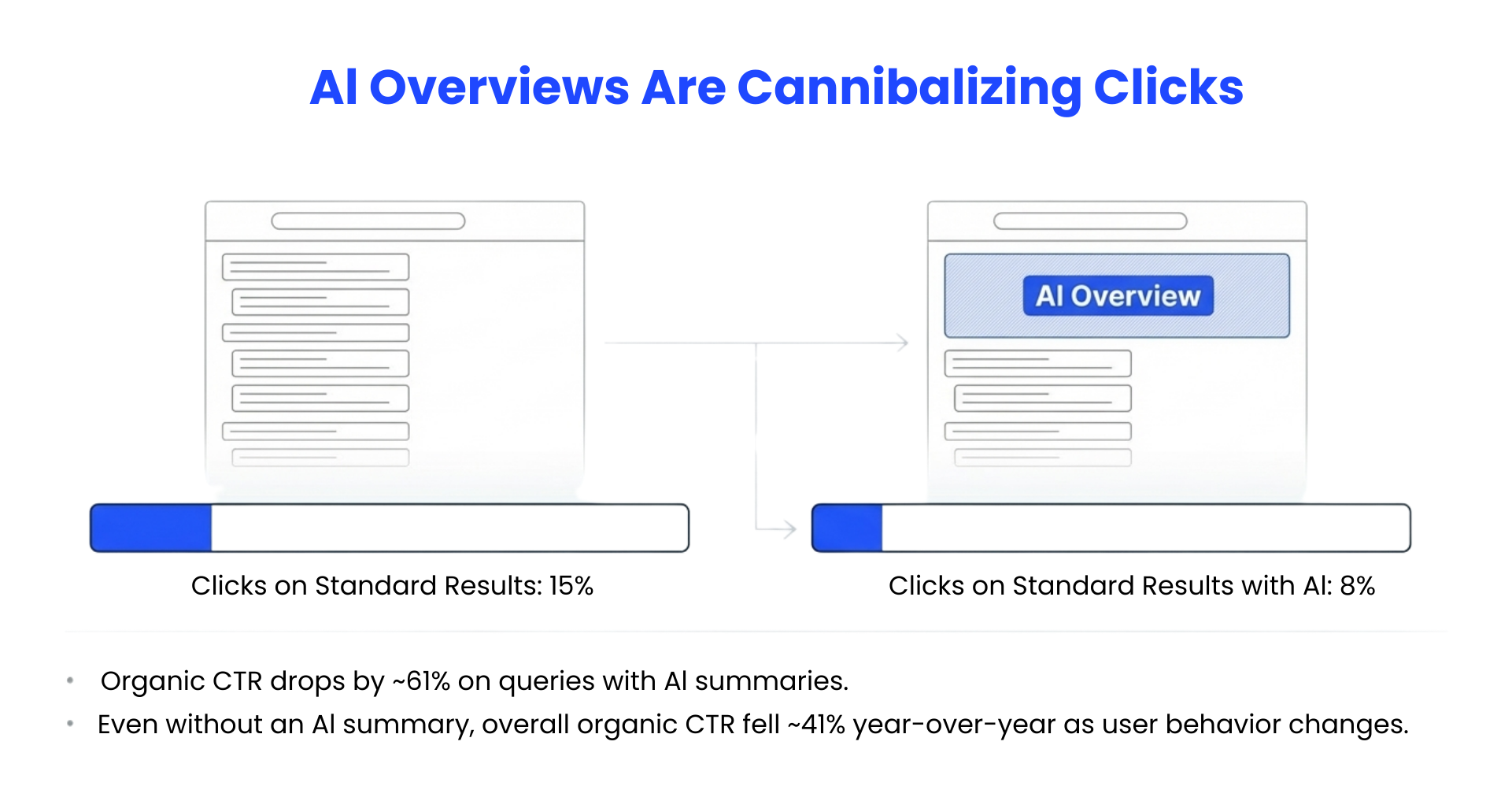
Proof that Google is cannibalising clicks to the open web through the introduction of their AI overviews. Google claims that AI overviews increase click-throughs to websites, but multiple studies have proven this to be false.
19. 26% of users stop searching after viewing an AI answer (source)
The challenge is less about generating clicks and more about ensuring your brand is represented in the summary that ends the search.
20. Organic CTR dropped about 61% and paid CTR fell 68% on queries with AI summaries after mid-2024 (source)
This is one of the clearest signals that traditional SERP real estate is being redefined. SEO strategies now need to incorporate AI snippet eligibility, schema precision, and content built for entity-level understanding.
21. Even on searches without AI summaries, organic CTR fell ~41% year-over-year (source)
Users are getting answers faster and clicking less overall. SEO is shifting toward strategic depth: owning authoritative positions, earning brand mentions in AI answers, and strengthening visibility across multiple discovery channels.
Bottom Line
CTR is still the clearest window into how people behave on Google. Users click what they see first, they rarely bother to explore, and they often end their search before any site gets a visit.
Ranking still matters, but winning the click now requires more than position. It requires earning attention in a results page that feels increasingly self-contained.
AI and Search Collide: The New SEO Frontier
AI is changing how people search, how Google organizes information, and how marketers compete for attention.
The leaders in this new system will be the ones who adapt to how AI interprets depth, structure, and authority.
1. AI Overviews surged early in 2025, then retreated (source)
Semrush data across 10 million keywords shows AI Overviews expanding quickly and then pulling back over the year:
- January: 6.5% of queries triggered an AI Overview
- July: peaked at just under 25%
- November: fell below 16%
Overall, this suggests Google increased coverage rapidly, then reduced it after observing performance at scale.
2. Nearly 60% of Google searches end without a click to a website (source)
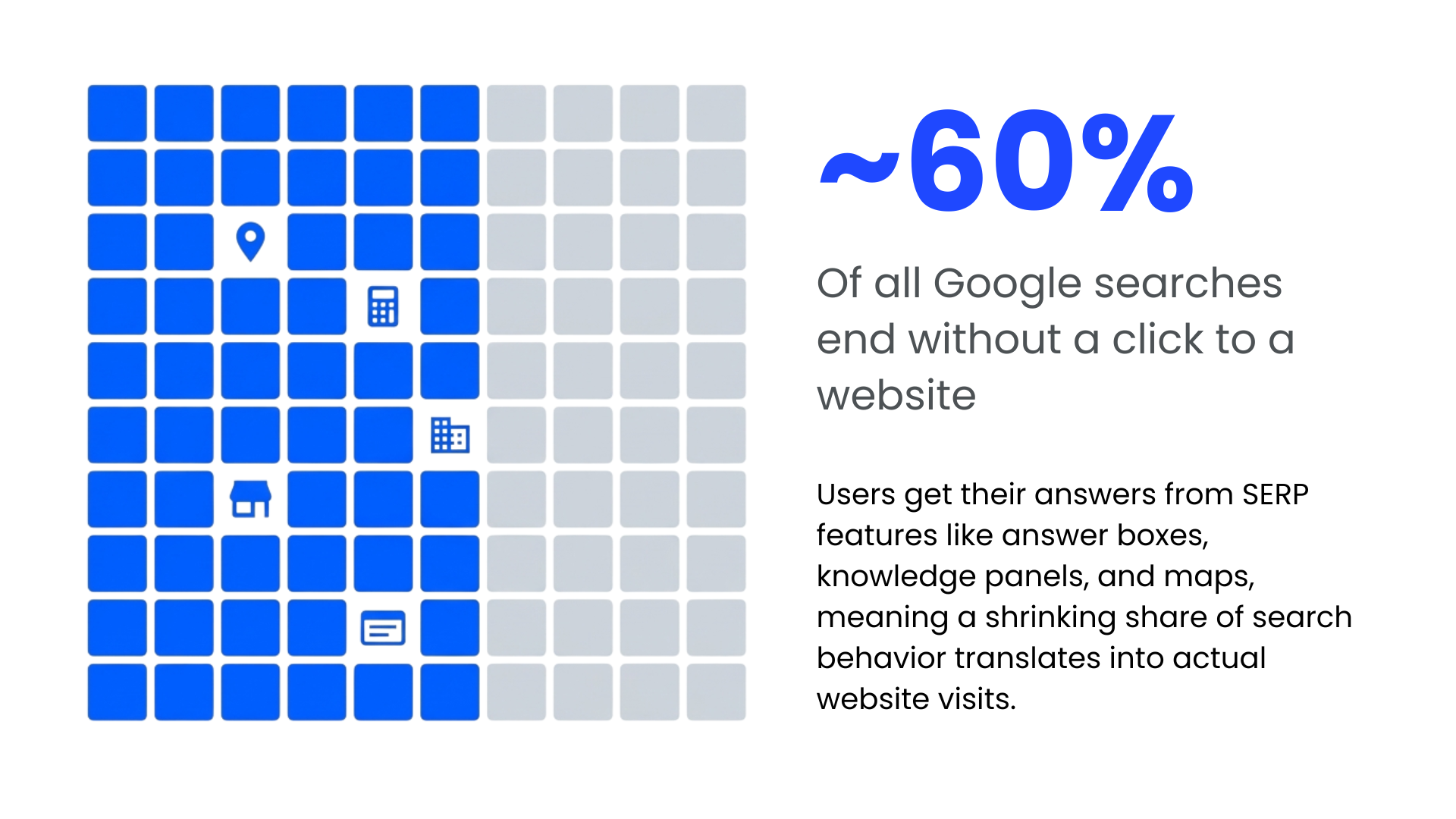
Google is collapsing steps in the search journey. That does not eliminate opportunity. It changes the goal. The new objective is being cited, surfaced, and summarized.
3. Position one loses about 34.5% of its CTR when an AI Overview is present (source)
When an AI Overview appears, the #1 organic result sees a significant CTR drop. For example, if position one typically earns ~38.5% CTR, a 34.5% reduction would bring it closer to ~25%.
The listing may still attract clicks, but the AI Overview captures a portion of attention that previously went to the top result.
4. Ads alongside AIO rose from about 3% of queries in January to roughly 40% in November 2025 (source)
In 2025, ads appeared alongside AI Overviews much more frequently, increasing from about 3% of queries in January to roughly 40% by November.
This indicates AI Overviews were increasingly shown in layouts that also include paid placements.
AIO volatility and intent shifts
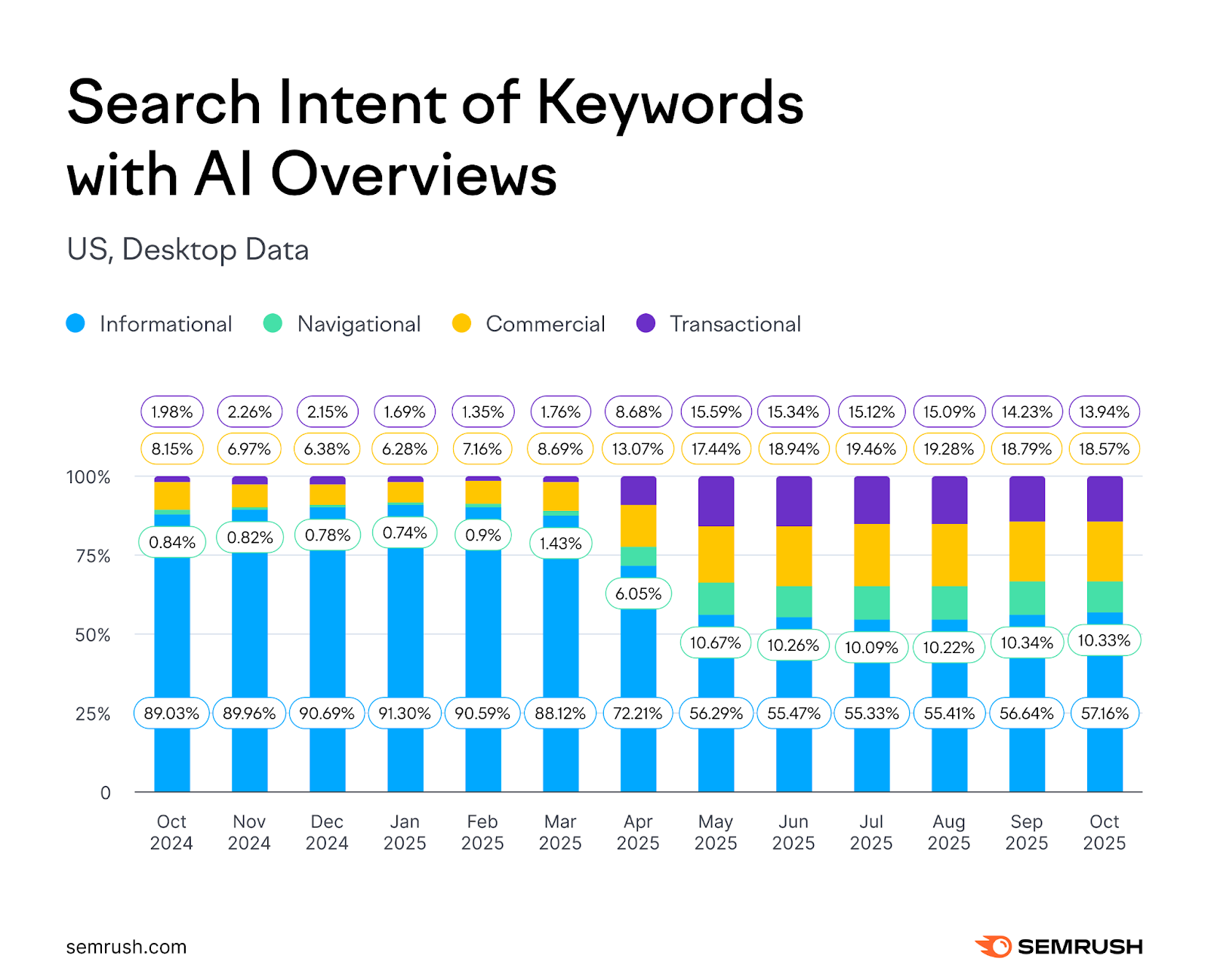
5. Informational AIO coverage fell from 91% in January to 57% in October 2025 (source)
The share of AI Overviews triggered by informational queries decreased over the year, from 91% in January to 57% in October.
This implies that AI Overviews became less concentrated in purely informational searches over time.
6. Commercial AIO coverage increased from 8% to 18% in 2025 (source)
Commercial-query AI Overview coverage increased from 8% to 18% across 2025.
As AI Overviews expanded further into commercial intent, they likely affected how often product and service pages received clicks from high-intent searches.
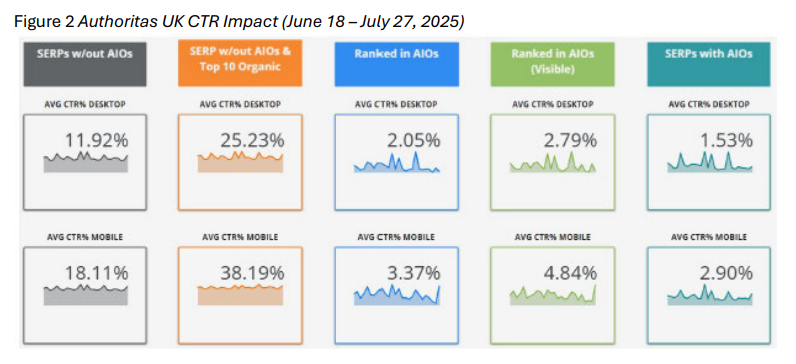
7. AI Overviews can reduce clicks by as much as 89% on affected queries (source)
DMG Media‘s submission to the UK Competition and Markets Authority reads clear as day. Their study shows AI Overviews draining up to 89% of clicks from media content.
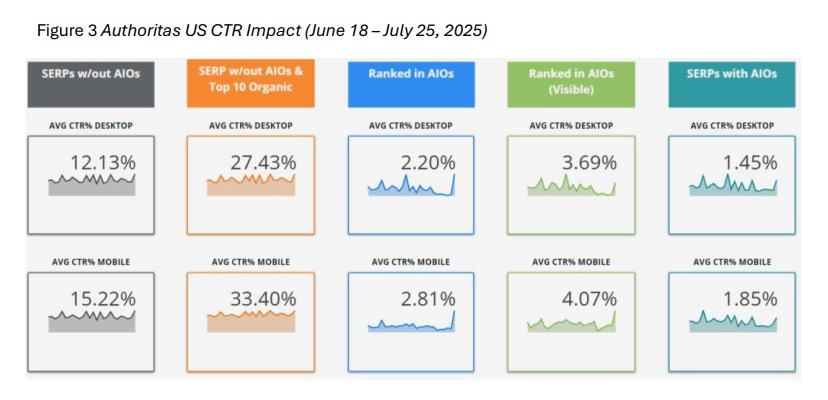
This is the kind of loss that doesn’t require interpretation.
DMG owns some of the biggest news brands on the planet, and even they are watching their search traffic evaporate every time Google decides that an AI-generated paragraph is a sufficient substitute for journalism.
8. Transactional AIO coverage jumped from 2% to 14% (source)
This suggests AI Overviews expanded further into purchase-ready searches. In other words, Google began showing AI summaries more often at the point where users are close to taking action.
9. Navigational AIO jumped from under 1% to over 10% by November 2025 (source)
Google is now summarizing brand searches. Someone types your business name, and Google starts “explaining” you before they even reach your homepage.
10. Bottom-of-SERP ads appear on about 25% of AIO pages (source)
Ads are increasingly appearing below AI Overviews, with bottom-of-page placements present on roughly 25% of those results.
This reflects how monetized elements are being integrated throughout more parts of the search results page, including alongside AI-generated summaries.
11. Science leads all industries with 25.96% AIO saturation, followed by Computers & Electronics at 17.92% and People & Society at 17.29% (source)
Subjects that require nuance and precision are receiving the highest dose of AI summarization.
12. Food & Drink saw the fastest AIO growth since March (source)
Recipes and food content became AIO’s playground. If your food blog traffic dipped, it was not your cooking. It was Google deciding it could write the recipe faster.
13. Real Estate, Shopping, and Arts & Entertainment remain under 3% AIO coverage (source)
Google is being extremely careful with categories where mistakes cause legal problems or refund requests. Apparently, we draw the line at AI guessing home valuations.
Impressions rise while clicks fall
14. Search impressions have increased by about 49% since AI Overviews launched (source)
More impressions theoretically mean more visibility. But without clicks, it’s very difficult to measure and attribute the user journey. A user might see your brand 7 times in AI overviews before they Google your brand name and browse to your website. There’s currently no way to track this.
15. Click-throughs from organic results have dropped nearly 30% in the same window (source)
Searchers are exploring more but clicking less. The field of AI search optimization has grown as companies look to be cited directly by LLMs to counteract the downward trends of traditional SEO.
Marketers are pivoting toward the AI-era SEO
16. 68% of organizations are already adjusting their search strategies for AI results (source)
Teams are shifting from keyword lists to citation-worthy content. They are prioritizing clarity, structure, and expert positioning. Off-site brand mentions also play a huge part in appearing in AI search results.
17. 57% of marketers are cautiously optimistic about AI summaries (source)
Marketers are watching early shifts closely. Many see AI results as room for strategic innovation rather than disruption. The landscape is changing quickly, and teams expect more predictable patterns as Google refines how AI interacts with traditional rankings.
18. 86% of SEO professionals now use AI in their strategy (source)
AI is becoming foundational to modern SEO. It speeds up competitive analysis, clustering, auditing, and content development. Teams using AI report better velocity and consistency, which means AI is evolving into a core operational tool rather than an experimental add-on.
Consumer trust in AI answers is growing slowly
19. 65% of U.S. adults report seeing AI summaries in search (source)
Most users have already encountered AI summaries, even if they did not realize they were looking at a new layer of Google’s interface.
The feature has blended into everyday search behavior, which says a lot about how quickly people adjust to new formats when the experience feels convenient.
20. About 53% trust AI summaries somewhat, and 6% trust them fully (source)
Users remain cautious, and understandably so, because AI often hallucinates and must be cross-checked to verify information, particularly in technical and YMYL industries.
21. Only 20% say AI summaries are very useful (source)
Usefulness scores lag because users notice when an answer feels surface-level.
AI gives them a quick starting point, but the summary often lacks the depth they expect. This behavior creates a real opportunity for brands with strong authority.
When users want more detail, they still look for a source they can trust.
User preferences are splitting into two clear camps
22. 38% use AI summaries for at least half their searches (source)
These users want answers that feel instant. They treat AI summaries as a shortcut because they do not want to sift through a full SERP when they only need a quick sense of direction.
This group behaves like the new top-of-funnel audience. They skim, decide, and move on quickly.
23. 36% skip AI responses and click traditional results (source)
This group wants depth. They rely on organic results because they prefer information that feels complete and verifiable.
These users still behave like classic searchers. They click, compare, and expect real detail when the topic matters to them.
Bottom line
AIO behaves like a product that Google launched before finishing the manual. It spikes, collapses, wanders into new intent categories, and now has ads glued all over it.
The only way to stay ahead is to watch the pattern instead of the PR. AIO changes shape every few months, and your job is to track the behavior, not the slogans Google hands out when it wants everyone to calm down.
Mobile, Voice, and Local: The “Near Me” Ecosystem
The “near me” ecosystem has effectively turned every phone into a personal radar for whatever a user wants in the next ten minutes.
People rely on mobile search, voice prompts, and proximity signals to make fast decisions, and businesses either appear at that moment or they vanish from consideration entirely.
Mobile, voice, and local intent now operate as one connected system. If a business cannot show up cleanly when someone mutters “coffee near me” into their phone, it simply loses the customer to whoever can.
1. Over 60% of Google searches in the U.S. happen on mobile devices (source)
Mobile has become the first stop for discovery, comparison, and purchase decisions. A slow or clumsy mobile experience signals to both users and algorithms that a site is not ready for real competition.
2. Worldwide, 59.45% of all web traffic comes from mobile (source)
Global behavior shows a clear pattern. People now research everything on the move, and search engines prioritize the sites that respect that context.
3. Around 27% of people use voice search on mobile devices (source)
Mobile voice usage continues to climb because it fits into the flow of everyday life. People choose voice when typing feels inconvenient or unsafe, which makes mobile the natural home for this behavior.
4. About 43% of voice-enabled device owners shop with voice (source)
People say they “shop with voice,” but in practice, a lot of it is hands-free browsing. They’re asking for product info, checking prices, adding basics to a cart, or reordering something familiar.
5. 51% research products, 22% make purchases, 17% reorder via voice (source)
This breakdown tells a familiar story. People trust voice for tasks that feel low-risk, like reordering what they already know.
New purchases still require a visual double-check because nobody wants to accidentally buy the wrong thing.
6. 58% of U.S. consumers use voice search to find local business information (source)
Voice search is often used for high-intent local queries, like finding nearby businesses, checking opening hours, or getting directions. People want the fastest possible answer, and voice is built for quick, on-the-go searches.
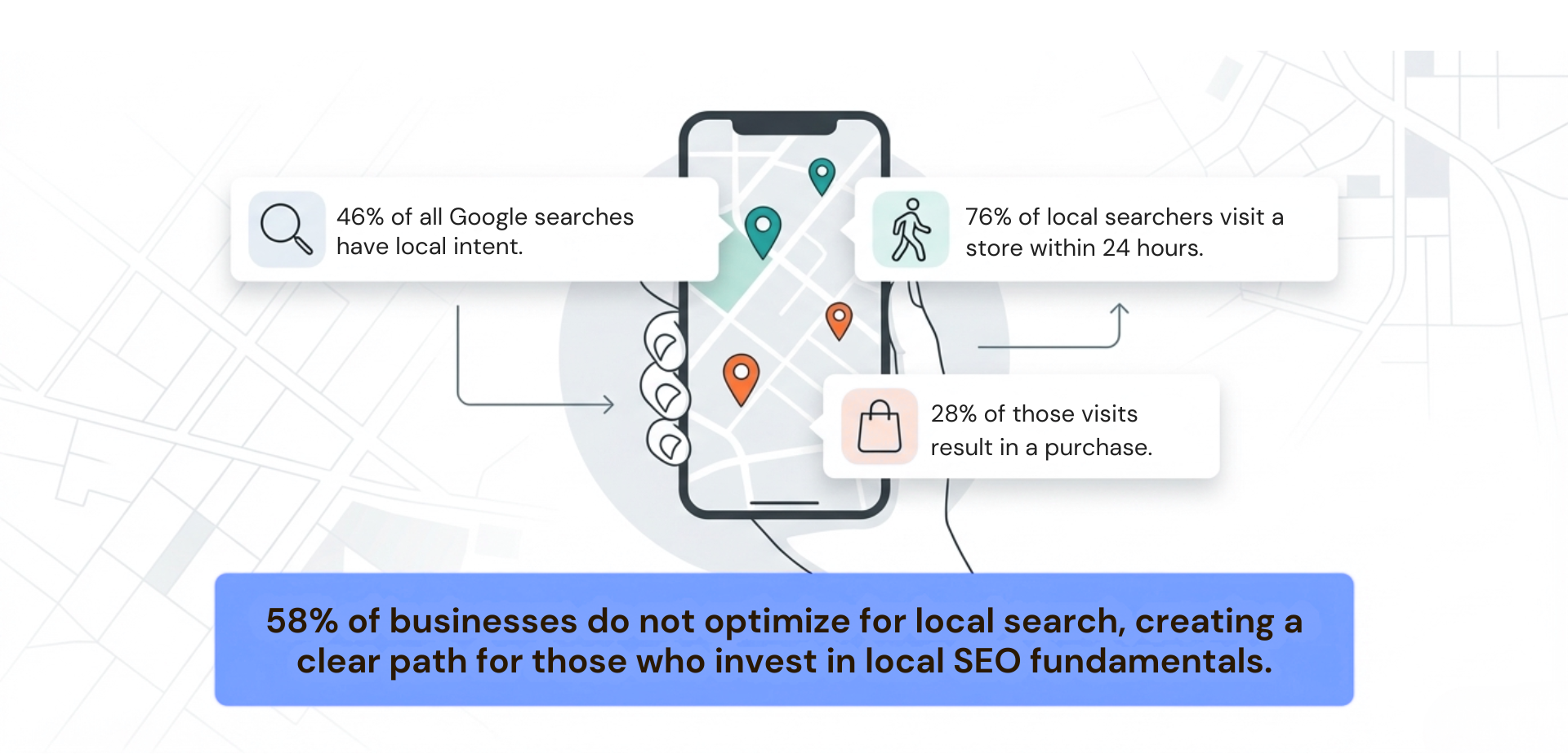
7. 46% of Google searches have local intent (source)
Nearly half of all searches carry some level of proximity-based interest. Users expect results that feel tailored to the exact street they are standing on.
A business that ignores local SEO signals creates its own visibility problem. Consumers are searching for nearby solutions all day, and Google can only show what exists in its ecosystem.
8. Nearly 70% of local searches occur on mobile (source)
Mobile and local function as one unified experience. People reach for their phones when they need something nearby, often while already on the move.
Local buying journeys frequently start before the user reaches their destination. A business that performs well on mobile becomes part of that decision simply by showing up at the right moment.
9. 76% of users who search for a local business on their smartphone visit within 24 hours, and 28% make a purchase (source)
When users search for nearby options, they are already close to taking action.
A strong local presence often converts directly into visits and revenue. These numbers show how tightly search behavior is connected to real-world outcomes.
10. Businesses in the Local Pack get 126% more traffic and 93% more customer actions than those ranked 4–10 (source)
The Local Pack functions as the real first page for local queries. Users often choose from the first three visible options without exploring further.
A business that earns placement in that block gains a significant advantage because the majority of local engagement concentrates at the top.
11. 80% of U.S. consumers search for a local business online at least once per week (source)
Local search is now a routine part of consumer behavior.
Businesses that maintain accurate listings, steady reviews, and consistent NAP+W signals stay aligned with how people make day-to-day decisions about where to shop, eat, or book services.
12. 35% of the U.S. SMBs have claimed a Google Business Profile (the basic local listing) (source)
This is one of the simplest local SEO wins available. Claiming and completing your profile helps you appear on Google Maps, collect reviews, and make it easy for customers to find your hours, location, and phone number.
13. 94% of high-performing multi-location companies have a dedicated local marketing strategy, compared to 60% of average-performing chains (source)
Top performers prioritize location-level marketing: accurate listings, consistent review efforts, and unique local footprints for each branch. Companies without a dedicated strategy tend to rely on broader brand campaigns, which can reduce visibility in local search.
14. Google completed mobile-first indexing in October 2023, which means mobile versions now determine indexing and ranking (source)
This makes the mobile experience the baseline. If your mobile pages are missing content, hard to navigate, slow, or visually broken, that can directly limit how well you perform in search.
In practice, strong SEO now requires that the mobile version include the same core content and functionality as the desktop.
15. Google recommends mobile page load times under 2.5 seconds to improve rankings with Core Web Vitals as the benchmark (source)
You don’t need perfection, but you do need to reduce avoidable friction. Faster load times improve the user experience and can support stronger search performance, especially on mobile.
If pages feel slow or unresponsive, visitors are more likely to bounce, and Google’s performance signals will reflect that.
Bottom Line
Mobile, voice, and local signals work together and shape the majority of real-world search decisions.
Users want fast answers, accurate listings, and a mobile experience that does not slow them down.
If you keep your information clean, your site quick, and your presence easy for both humans and AI assistants to understand, you stay visible at the exact moment people are ready to act.
Content and Links: The Enduring Foundations
Every year, Google rolls out dozens of changes: ranking updates, new SERP features, and major AI-driven shifts. And every year, the same question comes up:
Do content and links still matter?
Yes, consistently.
The sites that hold onto traffic through updates usually aren’t the ones chasing every new feature. They’re the ones publishing content people genuinely use, and earning links because others choose to reference them.
Once you strip away the hype cycles and product launches, the same fundamentals keep showing up in the results:
Useful content and credible links.
1. The number of linking domains is the strongest correlation to high Google rankings (source)
Across ranking-factor studies, referring domains sit near the top.
This doesn’t mean links magically cause rankings. It means Google uses broad endorsement as a vote for credibility.
If many independent sites reference a page, Google assumes it earned attention somewhere beyond its own metadata.
2. The #1 result gains 5%–14.5% more new dofollow links each month (source)
Once a page reaches the top, it becomes more visible to journalists, bloggers, and editors who are already linking to similar topics.
Those links arrive naturally and regularly, reinforcing the page’s position and making the #1 spot harder to dislodge over time.
3. Adding new backlinks increased organic clicks by ~14% and impressions by 275% (source)
Backlink acquisition continues to deliver measurable, short-term SEO impact. Rankings expanded to more keywords, visibility broadened, and pages captured more search demand.
This is what modern link-building looks like when executed with relevance: targeted links that expand a page’s footprint rather than inflate metrics.
4. Links from authoritative domains generated the strongest ranking gains (source)
“Authoritative” isn’t just a high score in third-party tools. This analysis suggests the biggest gains came from links on selective, editorially controlled sites that also perform well in search themselves.
Metrics like Domain Rating (DR) or Domain Authority (DA) are useful for quick screening, but they don’t reliably predict impact. They mostly reflect a site’s link profile, not how much weight Google assigns to links from that source.
5. Quality content sits atop Google’s ranking signals (source)
Surveys point to three factors consistently shaping top results: content quality, user experience, and backlinks.
Google’s emphasis on usefulness has only tightened with recent updates. Content that answers completely, clearly, and credibly continues to outperform clever formatting or keyword engineering.
6. The average first-page result sits around 1,447 words and earns 77% more backlinks (source)
Depth attracts attention and authority. Length itself does not rank, but comprehensive explanations earn citations, social distribution, and long-tail keyword coverage, the cornerstones of sustainable SEO performance.
7. The average top-10 ranking page is 2+ years old (source)
Nearly 60% of the top-10 results are older than 3 years. Reliability, depth, and ongoing relevance are what keep these pages anchored in competitive SERPs.
8. 87.6% of top Google results contain little or no AI-generated text (source)
Search results still skew heavily toward human-quality content. AI doesn’t disqualify content, but Google rewards expertise, originality, and usefulness.
AI can scale production, but only quality can scale ranking.
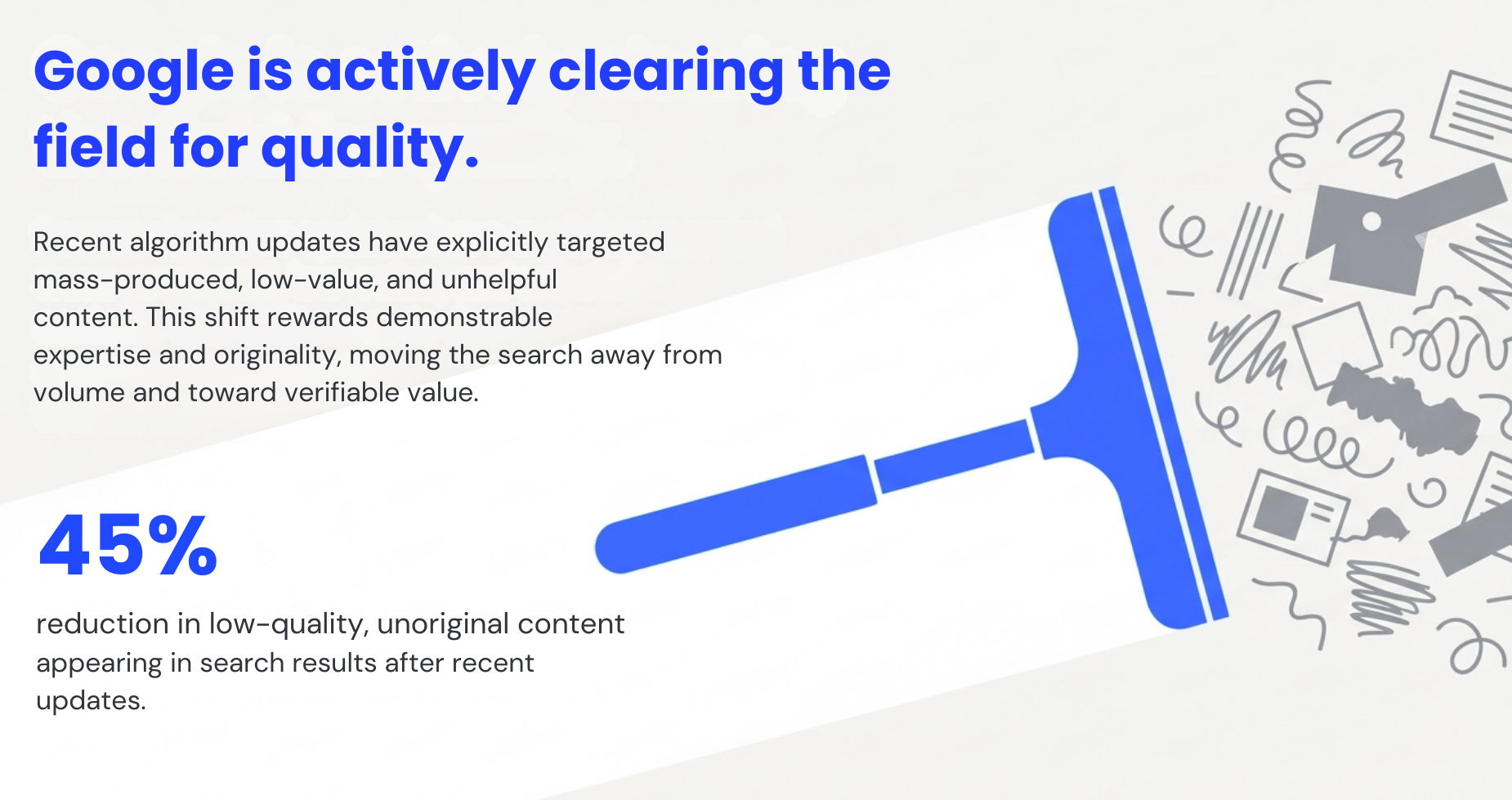
9. Google’s 2024 updates reduced low-quality content in results by 45% (source)
Google finally formalized what many sites were exploiting for years.
The March 2024 core update expanded the definition of spam to include scaled content abuse, site-reputation abuse, and expired-domain abuse, regardless of whether pages were written by humans, AI, or both.
Entire strategies built on repurposing thin content, licensing low-oversight third-party pages, or recycling expired domains lost visibility.
Bottom line
Every ranking study, every update, every messy traffic chart keeps circling back to the same reality: pages earn visibility when people talk about them, cite them, and stay on them.
The sites that rise are the ones other sites are willing to vouch for, and the ones users consider worth their time. If you want staying power in 2026, you need both.
The SEO Payoff: ROI and Industry Impact
SEO keeps earning trust because it keeps paying out.
Not in spikes. Not in short bursts. In steady, compounding returns that show up quarter after quarter.
These numbers explain why search remains the most durable growth channel most teams have, even as platforms, formats, and interfaces keep changing.
1. SEO returns $22 for every $1 spent, a 22:1 average ROI (source)
Very few channels create assets that keep working after the budget line stops. SEO does.
Once a page earns visibility, it keeps bringing in demand without asking for more spend.
2. B2B SaaS averages 702% SEO ROI, e-commerce hits 317%, and real estate climbs to 1,389% (source)
If you’ve worked in SaaS or real estate, this won’t surprise you. Buyers do their homework, circle back multiple times, and rarely convert on a first visit.
SEO stays with them through that entire decision cycle, showing up when questions change and confidence builds. Over time, those repeated touchpoints turn visibility into trust and trust into revenue.
3. SEO leads close at 14.6% compared to 1.7% for outbound marketing (source)
Search traffic arrives mid-decision. People are already looking for answers, comparisons, or providers. That context does most of the selling before a sales team ever gets involved.
4. SEO reduces lead costs by 61% compared to outbound channels (source)
Lower acquisition costs come from targeting intent rather than manufacturing it.
Search reaches people at the moment intent exists, which removes much of the persuasion tax baked into outbound strategies.
5. Organic search converts 84.62% more users than PPC (source)
Organic traffic carries built-in credibility.
Users arrive because they chose the result, not because it was placed in front of them. That context consistently produces stronger conversion behavior.
6. Half of marketers rate SEO as their highest ROI channel (source)
Leaders see SEO as the engine behind their best-performing funnels. As search evolves, the value of ranking for high-intent queries keeps rising.
7. Average SEO ROI across industries is 825% (source)
These returns accumulate gradually. Each improvement to content, internal structure, or authority strengthens the entire site rather than a single campaign.
The payoff grows because the system builds leverage over time.
8. Less than 10% of marketing budgets go to SEO, even though it remains one of the most efficient acquisition channels (source)
Most organizations still underfund SEO relative to its contribution.
Budget decisions often favor immediacy over durability, even when the data consistently show where sustainable growth comes from.
Bottom line
SEO rarely delivers instant, shareable wins. It’s not a launch moment or a quick tactic you can point to in a weekly update.
It’s valuable because it compounds. Done well, it creates a steady source of qualified demand that supports the business even when platforms, budgets, and algorithms change.
The State of Search in the AI Era
Search is changing quickly, and the drivers go beyond any single algorithm update.
Google’s interfaces are evolving, click behavior is shifting, AI-generated summaries are increasing, and mobile and local intent continue to shape how people discover businesses. At the same time, trust signals matter more because users have more options and less patience.
The statistics point to three realities: visibility is harder to earn, traffic is distributed differently, and “authority” is assessed more selectively than before.
- Treat visibility as a journey, not a single metric. Appearing across multiple surfaces (AI summaries, local results, featured snippets, and standard listings) can create repeated exposure, even when a click doesn’t happen. That repeated exposure increasingly influences consideration.
- Focus on queries that still require depth. When a question can be answered in a short summary, search engines will increasingly provide the answer directly. The strongest opportunities are topics where users need nuance, comparisons, tradeoffs, pricing, implementation steps, or evidence.
- Invest in brand recognition alongside rankings. If your content is surfaced without a click, brand recall becomes more important. Consistent naming, clear positioning, and recognizable expertise help drive direct searches and return visits over time.
- Build content that earns trust from people, not just algorithms. Content that performs through volatility tends to be supported by credible signals: original data, expert input, specific examples, clear authorship, and references that others are willing to cite.
- Use paid search selectively. SEO compounds over time, while paid search captures demand in the moment. As top-of-funnel clicks become less reliable, paid can be most effective on high-intent queries where the user is close to a decision.
Search remains one of the most durable growth channels, but it now rewards work that holds up under higher expectations: strong content, credible links, technical performance, and clear trust signals.

- 80+ Eye-opening SEO Statistics for 2026 - February 24, 2026
- 70+ Important U.S Small Business Statistics [2026] - June 7, 2026
- 80+ Revealing Remote Work Statistics & Trends [2026] - February 20, 2026
Get more traffic, get more conversions – all without paying for ads 

Let’s chat to see if we can help you multiply your SEO revenue.
Get more traffic, get more conversions – all without paying for ads
Let’s chat to see if we can help you multiply your SEO revenue.
