

In 2020, “remote work” was a temporary Band-Aid.

By 2023, it was a battleground between executives and employees.

In 2026, it’s now the operating system of modern work.

The office didn’t die. It just stopped being the center of gravity. Workers spread out. Meetings went async. Productivity became measurable instead of performative.

The concept of remote work has enabled the Growth Partners Media team to thrive in a way that wasn’t previously possible. So we took it upon ourselves to research and bring you the latest remote work statistics to share how this working lifestyle is changing the world.

The data represented in this article is the most recent data available on the state of global remote work.

The statistics below reveal the state of remote work in 2026, and what the next evolution of distributed workforces really looks like.

TL;DR – 2026 Remote Work Trends Shaping Working Lives

If you only read one section of this report, make it this one. These are the forces shaping how companies hire, how employees work, and how organizations compete in 2026:
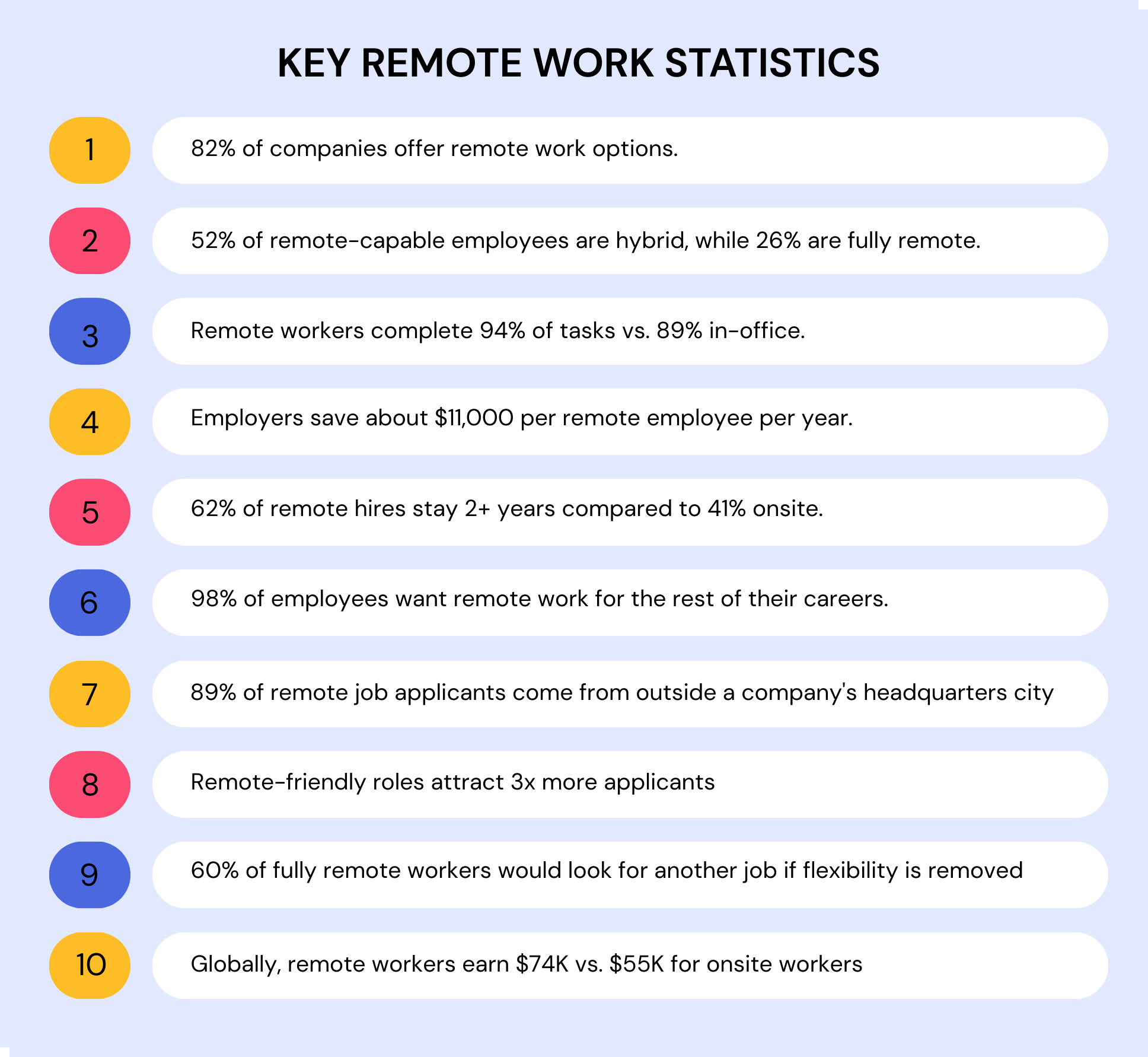
Infographic listing ten key remote work statistics, including the share of companies offering remote options, rise of hybrid roles, higher task completion rates for remote workers, employer savings of about $11,000 per remote employee, stronger retention for remote hires, widespread long-term demand for remote work, high interest from non-local applicants, increased applicant volume for remote-friendly roles, risk of turnover if flexibility is removed, and higher average salaries for remote workers globally.

1. 82% of companies offer remote work options.

2. 52% of remote-capable employees are hybrid, while 26% are fully remote.

3. Remote workers complete 94% of tasks vs. 89% in-office.

4. Employers save about $11,000 per remote employee per year.

5. 62% of remote hires stay 2+ years, compared to 41% onsite.

6. 98% of employees want remote work for the rest of their careers.

7. 89% of remote job applicants come from outside a company’s headquarters city.

8. Remote-friendly roles attract 3× more applicants.

9. 60% of fully remote workers would job-hunt if flexibility is removed.

10. Globally, remote workers earn $74K vs. $55K for onsite workers.
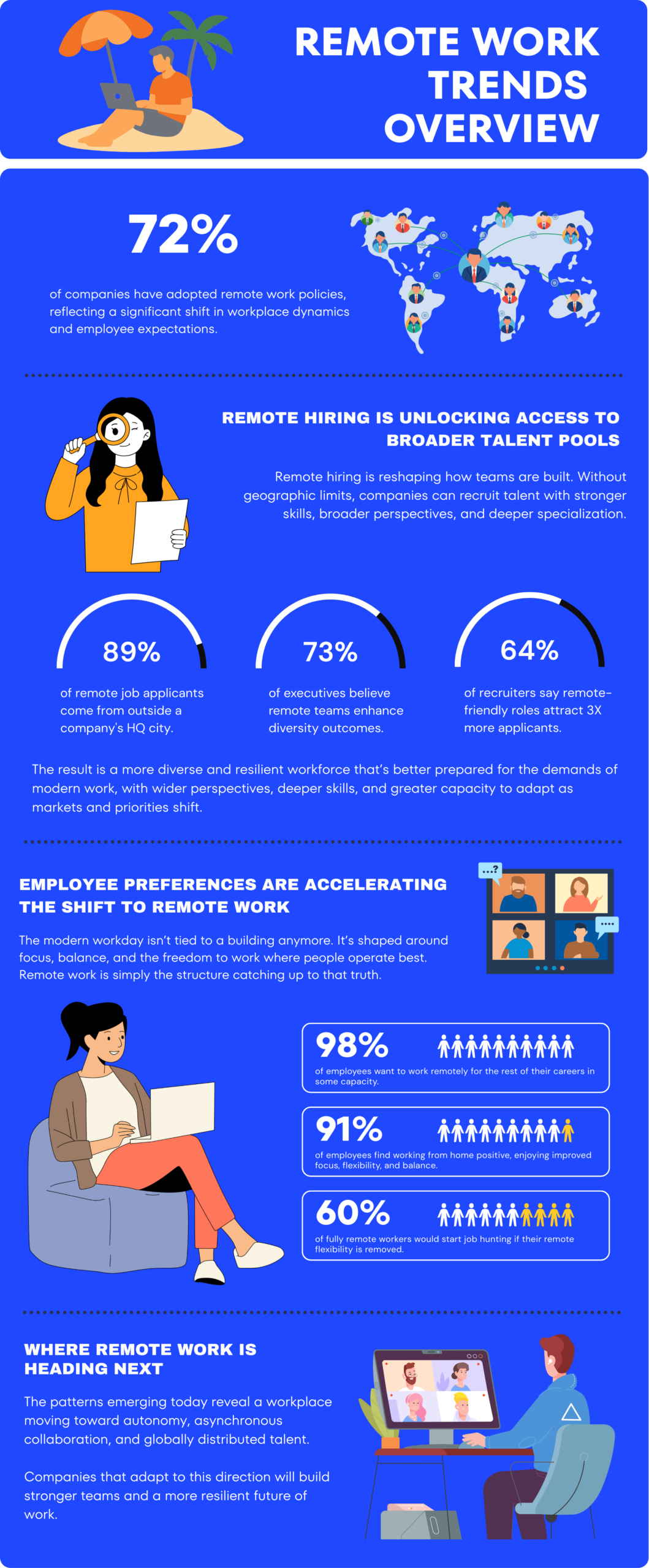
Vertical infographic titled “Remote Work Trends Overview.” It highlights key 2026 remote work statistics, including that 72% of companies have adopted remote work policies. A second section shows remote hiring trends with three stats: 89% of applicants apply from outside a company’s HQ city, 73% of executives say remote teams improve diversity, and 64% of recruiters report remote roles attract three times more applicants. Another section covers employee preferences, noting that 98% want remote work long term, 91% report positive work-from-home experiences, and 60% would job hunt if flexibility were removed. The final panel states that the future of remote work is shaped by autonomy, asynchronous collaboration, and globally distributed teams.

Embed this infographic

Copy and paste this HTML onto your site

Copied! 🎉

Remote work has moved from experiment to infrastructure.

Employees want it, companies benefit from it, and the data shows that flexible models outperform traditional ones in productivity, cost efficiency, and retention.

The office still has value, but it no longer defines work.

Remote Work Adoption & Usage

Remote Work Adoption

Remote work has graduated from experiment to the operating system of modern work culture. Companies are redesigning policies, real estate footprints, global hiring strategies, and employee expectations around it.

The numbers show a workforce that has shifted permanently into a flexible-first mindset, with remote and hybrid setups becoming the new baseline for productivity and retention.

1. 82% of companies now offer remote work options (source)

Remote work has moved from a rare perk to a default expectation. Companies that resist flexibility are becoming outliers, and candidates know it.

2. 72% of organizations have adopted permanent remote work policies (source)

After years of trial and adjustment, flexible arrangements are now codified in official policies instead of temporary guidelines.

3. Remote-first policies are used by 43% of businesses (source)

Illustration of a woman working remotely on a laptop with a statistic stating that 43% of businesses use remote-first policies designed for distributed teams.

Companies are designing communication, documentation, and team rhythms for distributed environments rather than retrofitting old office habits.

4. 61% of employees work remotely at least three days per week (source)

Hybrid work is the dominant model. Most employees treat the office as an intermittent meeting zone rather than a daily command center.

5. 28% of all workers globally operate fully remote (source)

Fully remote work has quadrupled since 2020. The share of employees who never step into an office continues to rise as more roles go digital.

6. 47% of companies allow employees to work from anywhere globally (source)

Geography has been decoupled from talent strategy. Employers are prioritizing skill over ZIP code, and employees already expect this freedom as a standard.

7. Flexible scheduling is the most popular reason employees choose remote work (source)

Across the US, UK, Canada, and Australia, more than half of remote workers say flexible scheduling is the top benefit of working from home. It outperforms perks like fewer distractions, better focus, cost savings, and even improved well-being.

Bar chart comparing the top benefits of remote work reported by respondents in the USA, UK, Canada, and Australia. Categories include flexible scheduling, lack of commute, cost savings, ability to care for family, reduced anxiety and stress, improved health, freedom to relocate or travel, ability to live anywhere, and reduced office politics.

8. Technology companies lead remote adoption at 94% (source)

The tech sector continues to set the pace for flexible work standards, influencing every other industry downstream.

The bottom line

Global and Demographic Remote Work Trends

Global and Demographic Remote Work Trends

Remote work adoption is not evenly distributed across the world or across age groups.

Geography, industry, generational expectations, and education levels strongly influence who works remotely and how frequently.

These numbers reveal how different regions and demographics are shaping the future of flexible work.

1. WFH averages 1.5 to 2 days per week in North America, the UK, and Australia (source)

These regions lead the global remote work movement. They have the digital infrastructure, cultural alignment, and organizational readiness that support sustained flexibility.

2. WFH averages 1 to 1.5 days per week across Europe (source)

European companies are easing into hybrid routines with steadier, more deliberate steps. Cultural traditions around in-office collaboration shape policy decisions, even as pressure for flexibility accelerates year over year.

3. WFH averages 1 day per week in Latin America and Africa (source)

Adoption is expanding, but national infrastructure gaps and industry mix slow the transition. Many organizations want greater flexibility; they are still building the conditions required to support it at scale.

4. Asian countries average 0.5 to 1 day per week working from home (source)

Remote work is growing, but deeply rooted workplace norms still favor physical presence. Leadership attitudes, hierarchical structures, and sector concentration result in slower movement toward hybrid models.

5. In the U.S., 39% of adults aged 24 to 35 work remotely full-time, and 25% work part-time (source)

Younger professionals embrace flexibility aggressively, and they expect remote options as a standard part of employment.

6. 38% of men in the U.S. work remotely full-time compared to 30% of women (source)

Gender gaps persist in remote access, which mostly reflects industry distribution rather than performance or preference.

7. Higher education significantly increases access to remote work (source)

Roles requiring analytical, technical, or writing-based work are more likely to be remote-friendly, which benefits degree holders.

8. Globally, remote workers earn an average of USD 74,000, while onsite workers average USD 55,000 (source)

Remote roles attract higher-skilled workers, and companies often pay more for specialized distributed talent.

9. Globally, hybrid workers earn the highest average salary at USD 80,000 (source)

Hybrid structures often support higher-level roles, increased responsibility, and stronger cross-team collaboration.

10. Employees with children are more likely to choose hybrid arrangements, while employees without children choose fully remote or fully onsite schedules (source)

Parents balance flexibility with a predictable structure, which leads to hybrid preferences across most regions.

The bottom line

Remote work is not a single global movement. It is a patchwork of regional habits, cultural norms, and generational expectations. Companies that understand these differences build better policies and attract stronger talent across borders.

Remote Work Productivity, ROI, and Performance

Remote Work Productivity

The productivity debate around remote work has lost its suspense. The numbers lean heavily toward flexible work structures, and the advantage is not subtle.

Remote teams are producing more, focusing longer, and costing less. Leaders who still insist performance lives inside office walls are arguing against the scoreboard.

1. Remote workers complete 94% of their tasks compared to 89% in office settings (source)

Remote work is delivering measurable productivity gains that are not tied to geography or office presence.

2. Remote workers spend 6.2 hours per day on deep work compared to 4.8 hours for office workers (source)

Deep work thrives when nobody is tapping your shoulder to ask if you “have a minute.” Remote setups give workers the focus that the office claimed to support but rarely delivered.

3. 62% of remote hires stay longer than two years compared to 41% for onsite hires (source)

Remote work is directly improving retention, which reduces churn, recruiting costs, and training overhead.

Line graph comparing remote hires and onsite hires, showing remote employees staying longer and maintaining higher retention. Side panels highlight key stats: remote workers complete 94% of tasks compared to 89% for office workers, and remote employees get 6.2 hours of focused work time versus 4.8 hours onsite.

4. 35% of remote employees feel more productive when fully remote (source)

Self-reported productivity aligns with actual task completion and output quality.

5. 71% of remote workers say remote work improves work-life balance (source)

Better balance creates better performance. Employees who are not burned out, sleep deprived, or stuck in traffic tend to work like humans who have a life outside their inbox.

6. 75% of companies report higher employee satisfaction with flexible work arrangements (source)

Satisfaction correlates strongly with performance, output, and stability across teams.

7. Employers save an average of $11,000 per employee by switching to remote work (source)

Lower real estate costs, leaner operations, and fewer onsite dependencies create financial breathing room. This is not a marginal savings line. It reshapes budgets.

8. 54% of organizations reduced office space by at least 30% after adopting remote work models (source)

Physical footprints are shrinking as companies invest more in digital collaboration infrastructure.

9. 87% of companies report higher onboarding satisfaction in remote structured onboarding compared to traditional onboarding (source)

Structured virtual onboarding removes guesswork. New hires get clearer documentation, faster access to resources, and fewer moments of “who do I ask about this.

10. 92% of companies conduct first-round interviews remotely (source)

Recruiting has gone digital for good. Video screening is now the default pipeline, saving time, travel, and scheduling headaches for everyone involved.

The bottom line

Remote work is not reducing output. It is increasing it. The gains in productivity, retention, and operational savings form a data-validated business case for making flexible work a core part of long-term organizational strategy.

Remote Work Talent & Hiring Trends

Remote Work Talent & Hiring Trends

Remote work is reshaping the talent market. Companies are no longer fishing in local ponds.

They are casting into global oceans where skill, speed, and specialization matter more than proximity.

The numbers reveal a hiring landscape that is faster, more competitive, and far more distributed than before.

1. 89% of remote job applicants come from outside a company’s headquarters city (source)

Global talent mobility is the new hiring default. Your next great hire probably lives in a timezone you have never Googled.

2. 93% of employers plan to continue conducting job interviews remotely (source)

Remote interviewing is now industry standard and significantly speeds up hiring cycles.

3. 68% of companies say remote work gives them access to better quality talent (source)

Removing geographic limits does more than widen the pool. It raises the bar. Companies are discovering specialists they would never have met through traditional local searches.

4. 73% of executives believe distributed teams improve diversity outcomes (source)

Remote hiring is broadening representation by removing barriers tied to geography, commuting costs, and proximity to major cities. Diverse teams are becoming a natural outcome.

5. 64% of recruiters say remote-friendly roles attract 3 times more applicants (source)

Demand for flexibility is overwhelming. Candidates flock to remote roles because they align with modern life, rising living costs, and the desire for time autonomy.

6. 51% of companies have expanded hiring into new international regions in the last two years (source)

Remote work is powering global expansion plans. Even mid-sized companies are now dipping into international markets once reserved for enterprise giants.

7. 78% of remote-first companies report faster hiring times than office-based companies (source)

Remote hiring removes most of the friction. No travel scheduling. No meeting room bookings. No, “we can only do Thursdays at 3.” Teams move from application to offer in record time.

The bottom line

Remote work has turned hiring into a global market where skill outranks location and flexibility outranks office perks. Companies that embrace distributed talent are building deeper pipelines, faster recruiting cycles, and stronger teams.

The organizations still tied to local-only recruiting and office-only policies are narrowing their options while everyone else widens theirs. Remote work is the new architecture of modern talent strategy.

Remote Worker Preferences & Sentiment

Remote Worker Preferences & Sentiment

Employees don’t see remote work as a temporary accommodation. They see it as a long-term lifestyle upgrade.

The numbers show a workforce that feels settled into flexible work and has no interest in reversing course:

Infographic titled “How Employees Really Feel About Working From Home,” showing four key statistics: 91% of employees say working from home is a positive experience, 68% rate their remote work life at the highest level, 98% would recommend remote work to a friend, and 98% want remote work to remain part of their schedule.

1. 91% of employees report a positive experience working from home (source)

The overwhelming majority enjoy remote work. Only 8% feel neutral, and 1% feel negative. Remote work satisfaction is practically its own fan club at this point.

2. 68% of workers say their work-from-home experience is very positive (source)

This level of enthusiasm is rare in workplace research. Employees are signaling that flexibility improves both their mood and their momentum.

3. 98% of employees would recommend working remotely to a friend (source)

If remote work were a product, it would be the only thing on the market with a near-perfect NPS and zero chance of churn. Employees are basically handing out rave reviews like they’re getting affiliate commissions.

4. 98% of people want to work remotely at least some of the time (source)

This is a global consensus that flexibility is now part of a fair work environment.

5. 67% say flexible scheduling is the top remote work benefit (source)

Employees want the freedom to design their workspace around concentration, comfort, and personal life instead of fluorescent lights and desk rotations.

6. 62% value the flexibility to choose their work location (source)

Location freedom is now a core part of job satisfaction.

7. 59% say saving time by not commuting is a major benefit (source)

The commute has become the most unpopular ritual in the professional world.

8. 55% value the freedom to live wherever they choose (source)

Remote work is reshaping where people live, raise families, and build routines. Life decisions are no longer controlled by a single corporate address.

9. 48% say remote work is better for them financially (source)

The savings add up. No commute, fewer expenses, and more control over spending.

10. 52% of professionals say increased productivity is the biggest benefit of remote work (source)

Employees trust their performance at home. They feel sharper and more focused when they control their environment.

11. 44% say remote work boosts morale, and 43% say it increases loyalty (source)

Flexibility builds goodwill fast. When people feel trusted, they give more and stay longer.

12. Tech employees overwhelmingly believe they are more productive at home (source)

Only 17% feel less productive, while 24% say productivity is unchanged. The rest believe remote work improves their performance.

13. 91% of remote and hybrid employees say they feel the same or more productive in their current model (source)

The majority of workers believe remote work supports their best output. Confidence like this carries real operational value.

The bottom line

The data shows clear, confident support for remote work across the workforce. Companies that respect these preferences are seeing gains in productivity, retention, and morale that office-bound teams struggle to match.

Employer Attitudes, Policies, and Organizational Reality

Employer Attitudes and Organizational Reality

Some leaders are embracing flexibility with genuine enthusiasm, others are dragging their feet, and a few are treating remote work like a seasonal allergy that will eventually go away.

Even with the internal tug-of-war, the direction is unmistakable. Flexibility is becoming a long-term strategic lever.

These numbers reveal how executives interpret culture, productivity, and the future of work inside their organizations:

1. 83% of US employers say remote work is successful (source)

Leadership confidence has quietly stabilized. Once the panic passed, executives realized remote workflows deliver more consistency than anyone predicted.

2. 71% of employees agree that remote work is successful (source)

Employee sentiment mirrors leadership. That alignment takes friction out of hybrid planning and makes adoption smoother for everyone involved.

3. Only 6% of employers say remote work is not successful (source)

This handful tends to sit in industries that treat physical presence as part of operational identity. For them, remote work still feels like flying a plane without the cockpit.

4. 59% of employers worry that remote work hurts company culture (source)

Culture anxiety remains every executive’s favorite talking point. Many fear culture evaporates without shared spaces, even though most cultures were built on values, not desk clusters.

5. Nearly half (45%) of companies mandating office returns say they did so to improve company culture (source)

Top executives like Jamie Dimon and others have publicly questioned remote work’s impact on mentorship and teamwork. This reflects a perception that being on-site bolsters collaboration and cultural cohesion.

6. 19 in 20 executives believe employees need some time in the office to maintain company culture (source)

Leaders want at least occasional face-to-face contact to remind teams they work for the same company. Culture, to them, is a muscle that weakens without in-person reps.

7. 29% of executives believe employees should be in the office three days a week (source)

This is the corporate comfort zone. Enough office time to soothe leaders, enough flexibility to reduce attrition. It is the safest compromise on the menu.

8. 23% of executives want employees in the office five days per week (source)

A dedicated group that still treats the office as sacred ground. They want structure restored, even if workers prefer autonomy over attendance.

9. 5% of executives believe employees do not need any office time (source)

A small but forward-thinking segment sees culture as a design challenge, not a location requirement.

10. 75% of businesses plan to downsize their office footprint (source)

Real estate does not shrink unless confidence changes.

Companies are trimming unused space because flexible work is turning square footage into a cost center instead of a competitive advantage.

11. 73% of executives consider remote workers a higher security risk (source)

Donut chart showing that 73% of executives consider remote workers a higher security risk, displayed next to the statistic in bold text.

Distributed workforces force companies to modernize systems that were once protected by physical firewalls and controlled doors.

12. 60% of companies use monitoring tools to track employee activity (source)

Digital oversight is climbing as leaders search for a balance between trust and control.

The bottom line

Employer attitudes are coalescing around hybrid structures that preserve culture, protect productivity, and reduce costs. The smartest organizations are moving past location debates and focusing on systems that make performance repeatable.

Remote Work Models, Structures, and Workflows

Remote Work Structures

Not all remote work setups perform the same.

Fully remote, remote first, hybrid, onsite hybrid, and location flexible arrangements each come with their own strengths and weak spots.

The data shows which models actually support productivity and which ones buckle when teams need structure.

1. 26% of US remote‑capable employees work exclusively remote, 52% are hybrid, and 22% are onsite (source)

Hybrid has officially graduated from experiment to default setting.

Most workers now live in a world where the office is an occasional destination rather than a daily requirement. The fully onsite population is the smallest group, which shows how far employee expectations have shifted.

2. Six in ten remote‑capable employees want a hybrid schedule, around one‑third want to be fully remote, and less than 10% want to work onsite (source)

Workers have voted with their preferences. Flexibility is no longer a talent perk. It is the baseline expectation.

Employers insisting on full-time office presence are building policies for a crowd that barely exists.

3. Over half (60%) of fully remote workers say they would look for another job if their remote flexibility is removed (source)

Retention is now tied directly to remote autonomy. Companies pressing for strict office returns are discovering that their top performers are willing to leave before they are willing to commute.

4. Only 11% of workers experience hybrid policies co‑created with their teams, yet those policies are seen as fair and boost collaboration (source)

Involving employees in schedule design is rare, but the payoff is huge.

When workers help shape hybrid rules, trust rises, cooperation improves, and compliance stops feeling like a chore. Leaders keep missing this very low-effort win.

5. 52% of US employees with remote‑capable jobs work hybrid, and 27% are fully remote, meaning 79% spend at least some time working remotely (source)

Nearly four out of five workers split their time between home and office. The idea of a workforce that “returns” to daily office life is no longer grounded in reality.

6. Fully remote employees show the highest engagement (31%) compared with 23% for hybrid and 19% for onsite workers, but they also report lower well‑being (source)

Autonomy boosts focus and results, but it also creates cracks when teams lack social or mental-health support.

Leaders need to treat engagement and well-being as two different systems instead of assuming one fixes the other.

7. 69% of managers say hybrid/remote work makes their team more productive, while only 12% say it’s less productive; at the individual level, 51% of employees feel more productive in their current work style (source)

The productivity debate is losing steam. Managers are seeing better results with flexible models, and employees feel sharper when they control their workspace.

Leaders who still claim remote work kills performance are arguing from nostalgia, not data.

The bottom line

Remote work models perform differently depending on the nature of the work and the people doing it. High-performing teams blend independence with intentional collaboration and give employees the freedom to work where they produce their best results.

Remote Work Challenges & Frictions

Remote Work Challenges

Remote work delivers freedom, focus, and flexibility, but it also introduces new pressure points.

Teams are navigating boundaries, communication gaps, and digital fatigue in ways that look very different from office era norms.

These statistics reveal the real frictions shaping the remote work experience.

Infographic showing four major challenges remote workers face: 22% struggle to unplug after work, 23% experience loneliness, 69% report digital burnout, and 53% feel disconnected.

1. 22% of remote workers say their biggest struggle is not being able to unplug (source)

Remote setups give people freedom, but they also blur the edges of the day.

Without a commute to mark the cutoff, work has a habit of following them into the evening. Many employees end up drifting between “on” and “off” until both start to feel the same.

2. 23% of remote workers say loneliness is a significant struggle (source)

Even highly productive remote workers notice the absence of spontaneous conversations and social cues. Humans are built for interaction, and remote work requires intentional connection, or the silence gets loud.

3. 69% of remote workers report increased digital burnout from communication tools (source)

Notifications multiply, and meetings stack up when companies try to replace hallway conversations with chat messages. The volume of digital noise is now a legitimate performance blocker for many teams.

4. 53% of remote workers say it is harder to feel connected to coworkers (source)

Connection does not happen by accident in remote work. Leaders need to design social systems intentionally, or teams begin to drift into isolated silos.

The bottom line

Remote work solves many old problems and quietly introduces a new set of ones.

Teams are balancing autonomy with isolation, flexibility with overextension, and productivity with digital exhaustion. These frictions are not signs of failure. There are signs that the way we work has outpaced the systems supporting it.

Companies that address boundaries, connection, and digital load directly will see remote work reach its full potential.

The Future of Remote Work in 2026 and Beyond

The Future of Remote Work

The last four years rewired the global workforce.

The Great Resignation exposed what employees actually value.

Quiet Quitting made it clear that people will not overextend without purpose.

The Great Detachment revealed a workforce that is overworked, under-recognized, and quietly scanning job boards during lunch breaks.

Remote work sits at the center of all of it, which is why 2026 is shaping up to be a decisive year for how flexibility survives, evolves, and scales.

Here is where the future is heading based on the latest numbers:

1. 98% of employees want to work remotely for the rest of their careers in some capacity (source)

Employee preference is no longer subtle. People want choice in how they work, and they consider it a career-long expectation, not a pandemic-era perk.

2. 76% of employees say they would start looking for a new job if remote work were removed (source)

Flexibility is a non-negotiable retention factor. Employees are willing to walk if leaders misread the room.

3. 84% of leaders pushing for flexible models are motivated by higher productivity (source)

The debate around remote and hybrid productivity is no longer emotional. It is data-driven. Leaders are choosing flexible structures because they see measurable gains in focus, velocity, and output.

4. 75% of business leaders expect to change their workplace model by 2026 (source)

Executives are planning around flexibility instead of resisting it. This number shows leaders are preparing for a future where rigid schedules are replaced with adaptive frameworks that can evolve.

Infographic titled “How Organizations Can Move From Intent to Implementation,” showing four stats: 62% of leaders want flexible models for better talent recruitment, 75% of employees say better tools are needed for hybrid work, 48% say return-to-office policies ignore what employees want, and 60% say commuting costs outweigh onsite benefits.

5. 62% of leaders want flexible models to improve talent recruitment (source)

The talent market is global and highly competitive. Employers know candidates gravitate toward roles that give them freedom to manage their time and location.

Hybrid is emerging as a recruitment asset because it attracts stronger applicants without inflating compensation.

6. 75% of employees say their company needs better tools and technology to support hybrid work (source)

The hybrid model does not survive on policy alone. It survives on infrastructure.

Employees want smoother communication, more reliable collaboration tools, and fewer technical outages. Technology is turning into the backbone of hybrid operations, not an accessory.

7. 48% of employees say RTO policies ignore employee desires to satisfy executives (source)

This disconnect is driving tension and edging companies closer to another wave of voluntary resignations.

8. 60% of employees say commuting costs outweigh any benefits of being on-site (source)

The math of in-office work is failing for many employees, and hybrid incentives must evolve accordingly.

The bottom line

The future of remote work in 2026 is shaped by three forces.

Employees who want autonomy. Companies that want productivity. Executives who want culture.

The organizations that win will reconcile all three with flexible policies, strong communication systems, and environments built on trust rather than surveillance.

Remote Work Isn’t a Trend. It’s the New Infrastructure of Work.

Infographic comparing on-site and remote work models. On-site workers show lower retention and fewer deep-work hours. Remote workers complete more tasks, log more focused hours, and save companies about $11,000 per employee each year.

If you made it to the end of this report, you can see the pattern clearly. Remote work is not drifting toward the future. It is the future, and everything else is adjusting around it.

The numbers tell a story that no executive memo can rewrite. Productivity is high. Retention is stronger. Satisfaction is through the roof. Talent markets are bigger. Costs are lower. The workplace is no longer a building. It is a system.

Remote work won because it works.

It gives companies sharper output.

It gives employees real autonomy.

It gives teams the freedom to perform rather than be present.

And yes, it introduces new challenges. Burnout, disconnection, digital overload, and structure gaps. But those are solvable. The friction isn’t a flaw in remote work. It’s a sign that our systems haven’t caught up with our reality.

In 2026, the winners will be the organizations that stop trying to force a return to an outdated model and start designing work around how people actually operate best.

Aishwarya Sinha

Get more traffic, get more conversions – all without paying for ads

Let’s chat to see if we can help you multiply your SEO revenue.

Get more traffic, get more conversions – all without paying for ads

Let’s chat to see if we can help you multiply your SEO revenue.