
There’s a pattern most B2B buyers recognize.
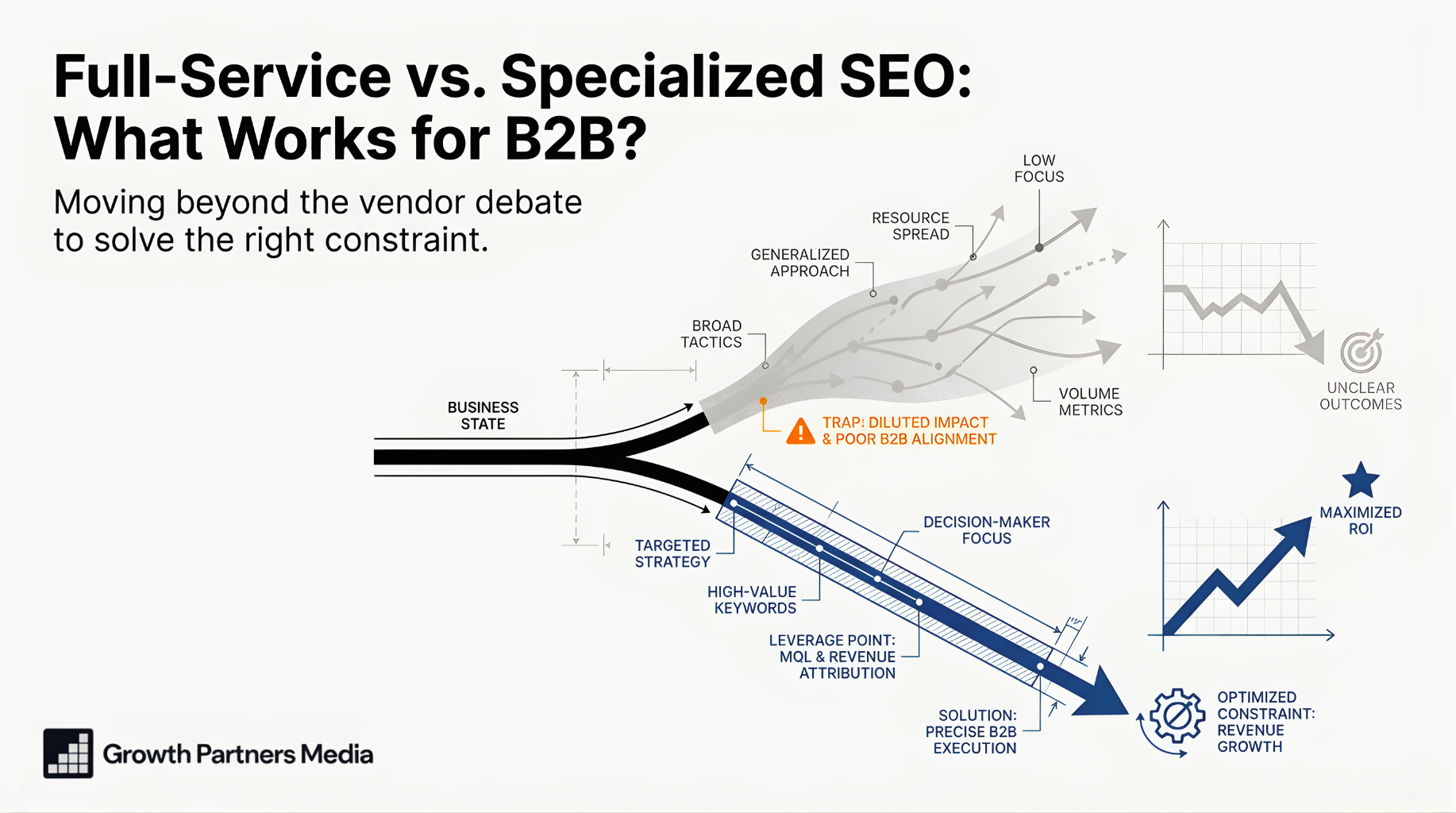
“All-in-one” platforms promise everything. In practice, they usually deliver acceptable performance across many functions, but rarely excellence in any one of them.
The same logic often applies to agencies.
A single contract feels efficient. One invoice. One point of contact. One integrated team. It sounds simpler.
But simplicity is not the same as depth.
And choosing the wrong model is not a minor mistake. It can waste six to twelve months solving the wrong problem while your real growth constraint stays untouched.
Complex B2B SEO challenges, like technical architecture, programmatic scaling, authority gaps, and category positioning, require focused expertise. These problems are rarely solved by teams dividing attention across paid media, social campaigns, creative production, and email flows at the same time.
Specialists spend years refining solutions to a narrow class of problems. Generalists spread that time across channels.
The result is not incompetence. It is dilution.
The real question is which model matches the constraint holding growth back right now.
This article breaks down how to make that call, and the signals that tell you when it is time to shift.
What People Mean by “Full-Service SEO Agency”
A full-service agency is the one-stop shop of the digital world.
They promise to handle every facet of organic growth under one roof, from technical audits and content strategy to link building, analytics, and sometimes paid media, too.
That model appeals because it simplifies vendor management. One partner. One reporting line. One team coordinating multiple moving parts.
For companies that need broad support and do not yet have strong in-house SEO leadership, that can be genuinely useful.
Here’s where they work well:
- Early-stage teams building the basics. When your marketing infrastructure is thin, you often need “good enough” execution across multiple disciplines quickly. Technical clean-up, foundational content, basic link earning, analytics, and conversion hygiene all matter. A competent full-service partner can lay the concrete.
- Teams without in-house SEO leadership. If you do not have someone internally who can steer the strategy, you need a partner who can do more than execute tasks. You need someone who can diagnose, prioritize, and run sequencing. Full-service agencies often position well here because they can own the full picture.
- Maintenance mode and baseline execution. When you are defending a position rather than trying to break into a competitive SERP, consistent upkeep across the board can be enough. In that context, breadth supports stability.
Important note:
Full-service is not inherently bad. There are some incredible generalist agencies out there.
The risk comes from surface-level execution. When an agency offers 15 different services, it is mathematically impossible for them to be in the top 1% of talent for all of them. You are often buying C+ work across the board.
What People Mean by “Specialized SEO Agency”
A specialized agency chooses one lane and commits to it.
They don’t try to cover every marketing channel. They focus on a single discipline or a single type of client and build depth over time.
That focus typically shows up in one of two forms.
- Service specialist: They master a discipline. Link building. Technical SEO. Programmatic content. CRO. They go deep on execution mechanics.
- Industry specialist: They master the environment. B2B SaaS. Fintech. Ecommerce. They build pattern recognition around what works inside that specific business model.
In both cases, you are buying depth.
Their testing, refinements, and pattern recognition are concentrated in a narrow domain. Over time, that usually creates sharper diagnoses and clearer judgment.
That depth matters, but only if the diagnosis is right. Specialization increases precision within the right problem set. It does not automatically make the solution relevant.
Three scenarios where specialization wins:
- The surgical strike: When you’re facing a defined technical bottleneck… indexation issues, crawl inefficiencies, structural problems. A specialist doesn’t need months of discovery. They go straight to the constraint.
- The force multiplier: Your internal SEO lead has the strategy but not the bandwidth. A specialist team plugs in and executes with focus and speed.
- The plateau breaker: Getting from Page 5 to Page 1 requires consistency. Getting from Position #5 to Position #1 on page 1 requires precision. Specialists look for narrow leverage points that general execution often misses.
A necessary warning:
Specialization does not guarantee quality.
There are “specialized” link builders selling spreadsheets. There are “technical experts” fixing issues that never affect revenue.
You’re not hiring someone because they specialize. You’re hiring them because their specialization produces results.
Make sure the depth translates into business impact.
The Real Trade-Off Isn’t Scope, It’s Depth
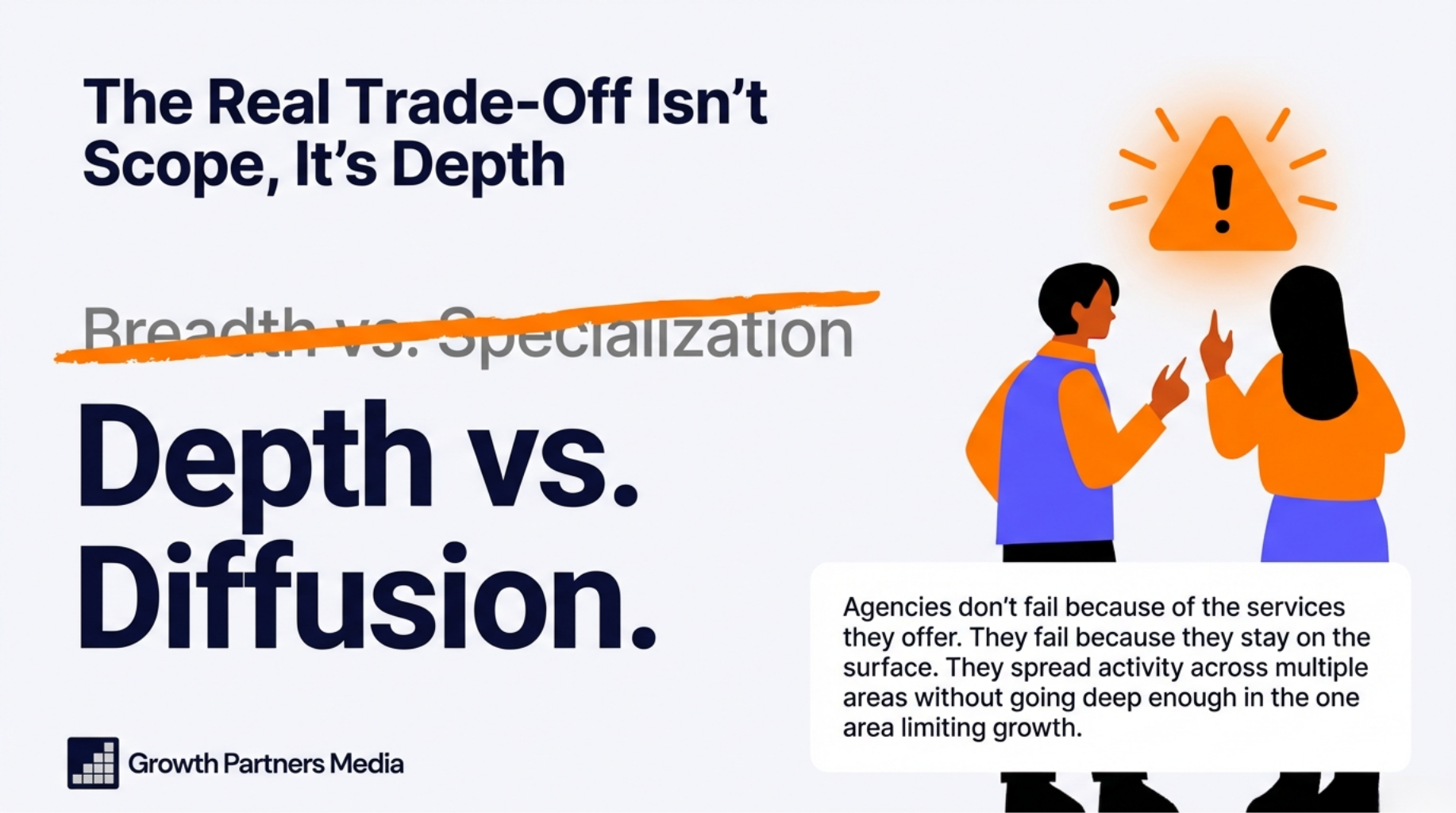
The industry frames the debate as breadth versus specialization.
The real trade-off is depth versus diffusion.
Many agencies fail their clients because they’re too surface-level. They spread activity across multiple areas without going deep enough in the one area that’s actually limiting growth.
SEO is a constraint-driven channel:
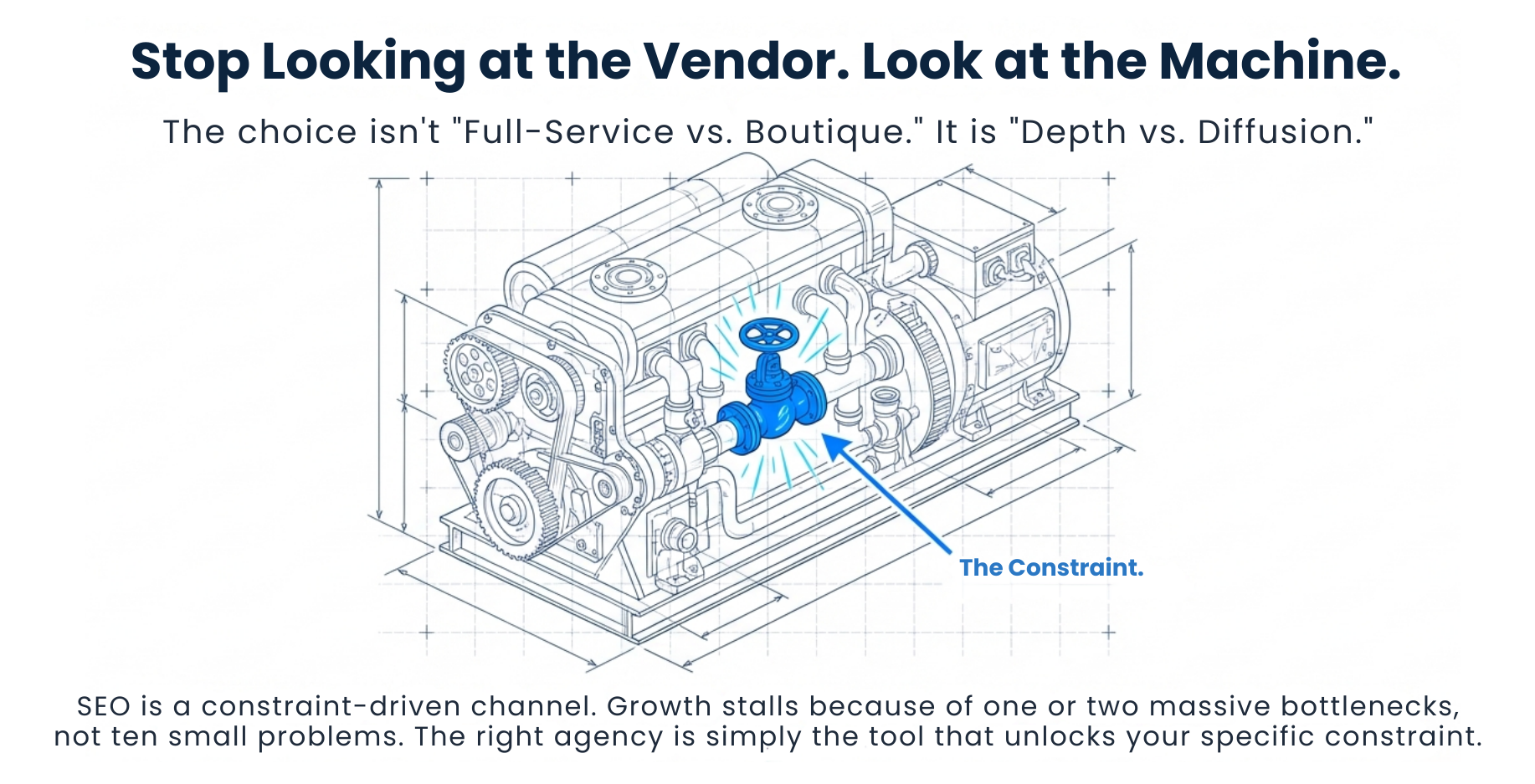
Growth rarely stalls because of ten small issues. It usually stalls because of one or two meaningful bottlenecks. It might be a technical limitation affecting crawl and indexation. It might be an authority gap preventing key commercial pages from ranking. It might be content that lacks the specificity needed to win bottom-funnel searches.
If you hire a generalist to solve a specific constraint, the work often gets diluted. A few links. A few blog posts. Minor on-page tweaks.
The reports look grear but the constraint remains.
Breaking a bottleneck requires focused pressure. It requires depth.
The important question is whether your agency partner can identify the real constraint and apply enough concentrated effort to remove it.
Where Full-Service Agencies Often Struggle
This isn’t an attack on full-service agencies. Many are led by smart operators with strong intentions.
The challenge is structural.
1. The generalist trap
In a full-service model, attention is divided.
The same team might be handling SEO, paid media, and content production across multiple accounts. That doesn’t make them incapable. It simply means their focus is fragmented.
You often end up with capable generalists executing work that demands specialist depth.
They can maintain momentum, but they rarely create breakthroughs.
In B2B SEO, that often means defaulting to content calendars and routine optimization while the real authority gap or technical bottleneck stays unresolved.
2. The illusion of busyness
Because they are doing so much, full-service agencies often hide behind volume.
They report on blog posts published, technical issues resolved, and traffic graphs moving in the right direction.
It creates a busy dashboard. It looks like progress. But activity doesn’t equal impact.
A B2B company can publish content every month and still see no movement on the pages that actually drive pipeline. If the primary constraint is untouched, output is irrelevant.
3. Margin pressure
To maintain margins while offering ten different services, agencies often rely on junior staff or offshore execution. This isn’t anything malicious but it means the person working on your account likely has less experience than you do.
They’re executing a process, not exercising judgment.
Where Specialized Agencies Often Fall Short
Specialists are not immune to failure. Their problems just look different.
They don’t die from doing too much. They die from doing one thing in a vacuum.
1. The “hammer and nail” bias
When you hire a vendor who sells hammers, everything starts to look like a nail.
If you hire a link-building agency, they will build links. They will build them if your technical SEO is broken. They will build them if your content is terrible. They will build them even if your dev team just botched a site migration and broke every single redirect chain.
A specialist is incentivised to execute their specific playbook. They’re not incentivised to tell you their playbook is the wrong solution for your problem.
You can easily burn six months of budget driving high-octane fuel into a car with a broken engine.
2. The integration vacuum
Specialists often operate in silos.
Your link builder lives in one Slack channel. Your technical auditor lives in another. Your content writer is a freelancer you found on LinkedIn.
Unless you have a strong internal leader connecting these dots, you can end up with disjointed execution.
The link builder builds authority to pages that convert at zero percent. The technical SEO blocks pages that the content team just optimized. Without a central brain to coordinate the limbs, the body can move in four different directions.
3. The “checkbox” trap
Specialized vendors are the easiest to commoditize. Because the scope is so narrow, the relationship often degrades into a transaction.
- “We delivered 10 links.”
- “We fixed 20 errors.”
- “We wrote 4 articles.”
The agency focuses entirely on the deliverable because that is what they sold you. They stop looking at the revenue impact. You end up with a very efficient spreadsheet of “completed tasks” that might not add up to very much when it comes to conversions.
The Question Most Leaders Should Be Asking Instead
Stop asking if you need a full-service or specialized agency.
That question forces you to look at the vendor market. You need to look at your own business needs instead.
The best marketing leaders start with a different question:
“What is the single primary constraint holding us back right now?”
The right agency model is simply the tool that unlocks that specific constraint. Once you identify the bottleneck, the choice of partner becomes obvious.
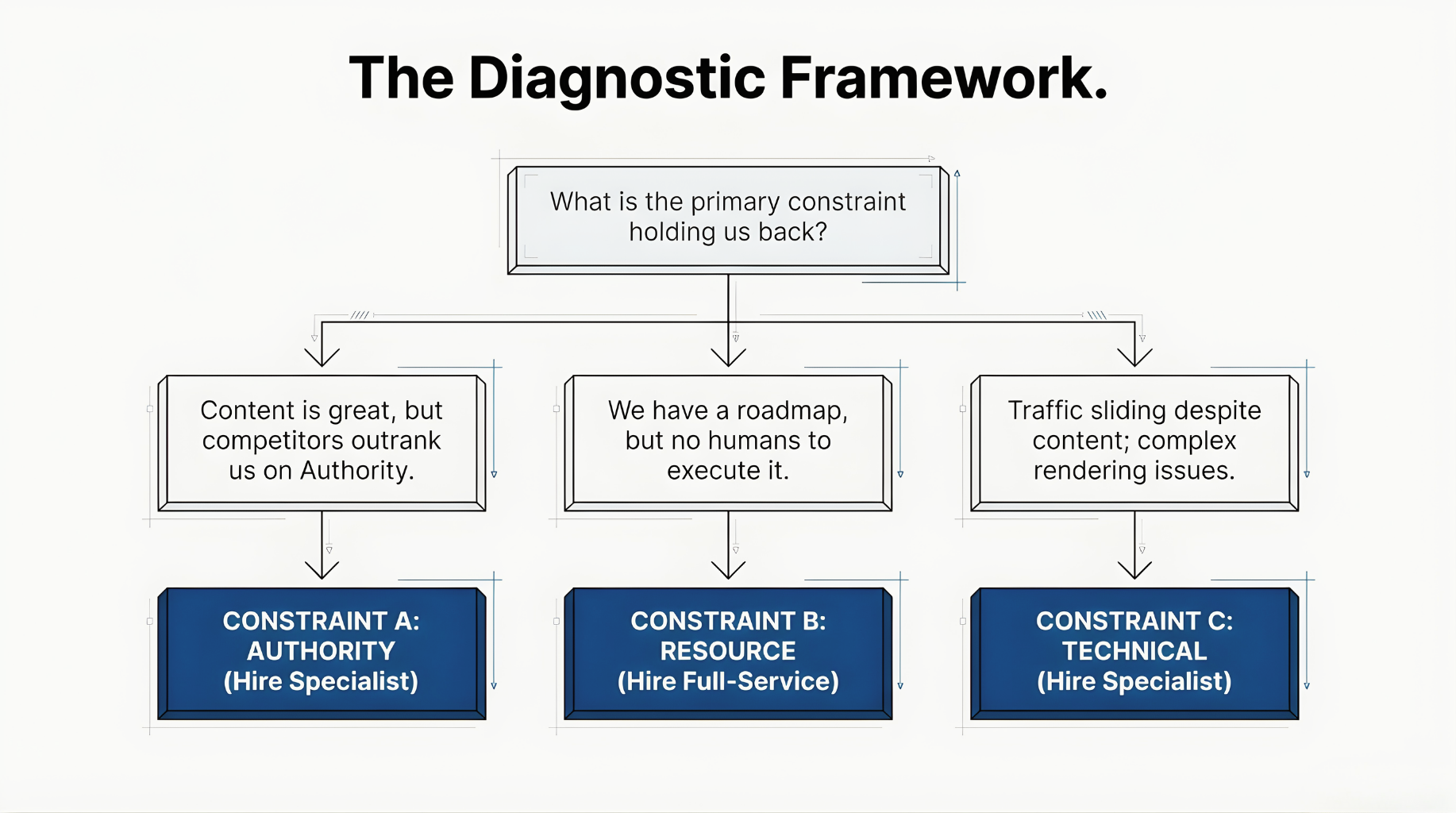
1. Authority constraint
The symptom:
Your content is objectively better than your competitors. You cover the topic with more depth. You have better data. Yet they outrank you purely on Domain Rating (DR).
The solution:
You need an outsourced specialized link-building or digital PR partner. Most generalist agencies are not built to generate the link velocity required to close a 20-point DR gap. This usually requires a team whose off-page work is a core capability, not a side function.
2. Resource constraint
The symptom:
You know exactly what to do. You have a clear roadmap. You simply have zero humans to execute it. You need to publish 10 blogs and fix 20 technical errors this month and you’re the only person on the team.
The solution:
You need a Full-Service Agency to help with resources. You don’t need a high-level strategy. You need arms and legs. A generalist team is perfect here because they provide immediate execution across multiple channels.
3. Technical constraint
The symptom:
You’re an enterprise SaaS with 100,000 programmatic pages. Traffic is sliding despite publishing new content. You suspect crawl budget waste or rendering issues.
The solution:
You need a Specialized Technical SEO consultant or agency. A generalist account manager is unlikely to be equipped to handle complex rendering, indexation, or JavaScript SEO issues.
You need a specialist who can diagnose the problem properly and go deep on the fix. Top agencies will help you diagnose these constraints before they send you a contract.
How We’ve Seen the Best Outcomes Happen (Across 5 Years)

After working with dozens of B2B businesses over the years, a pattern becomes clear.
The companies that win rarely stick to one agency model forever. They evolve.
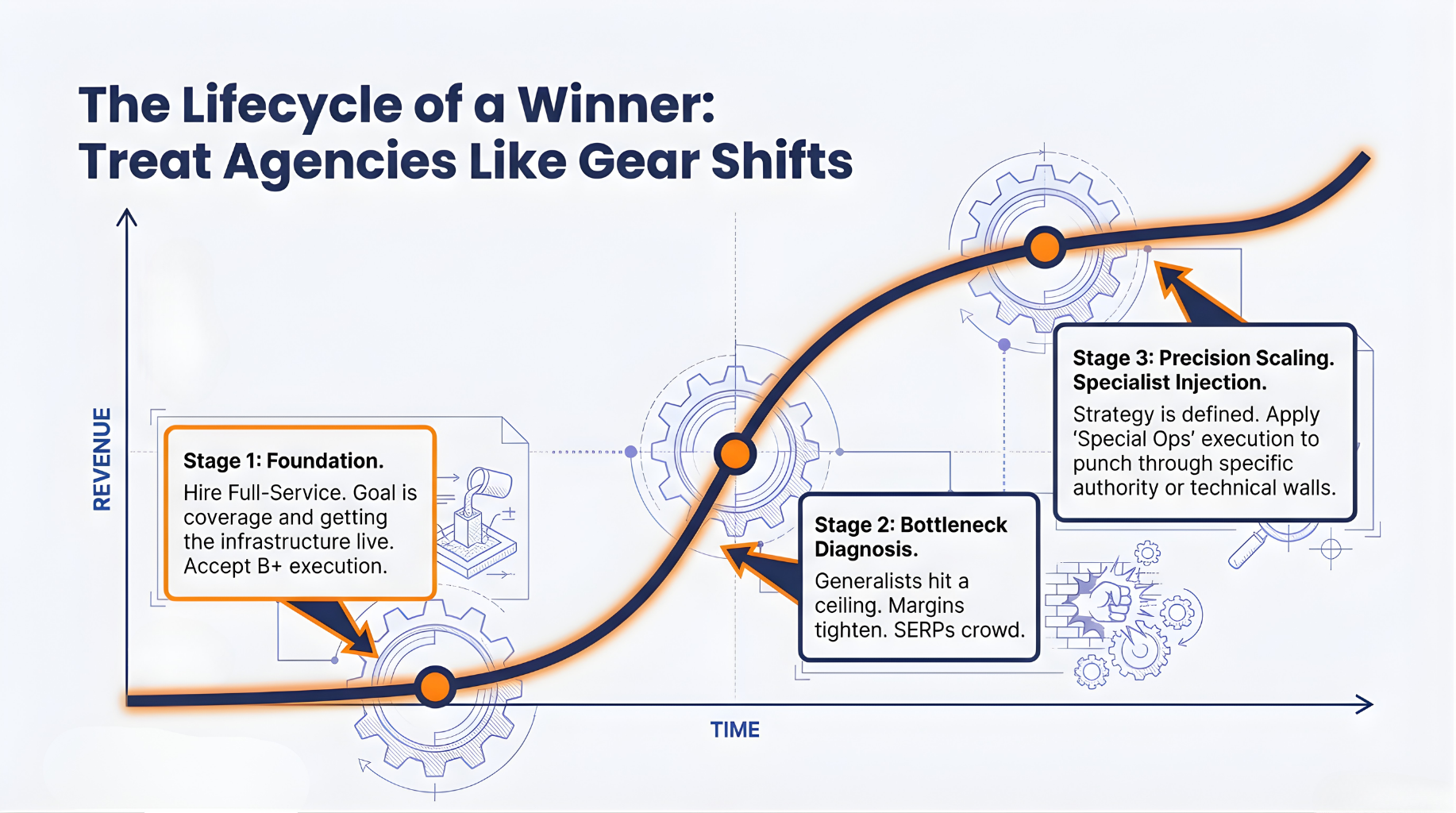
Think of agencies like gear shifts. You don’t stay in first gear on the motorway. You also don’t start in fifth.
Here’s what the lifecycle often looks like:
Stage 1: Foundation
Early on, you need coverage.
You need a site that works. Content. Analytics installed properly. Technical fundamentals in place.
At this stage, a competent full-service agency or strong freelancer can be ideal because the goal is setting up your infrastructure, not dominating the SERPs (yet).
Stage 2: Bottleneck diagnosis
Eventually, the generalist model hits a ceiling.
You’re now competing for high-intent terms against established players. This is where depth starts to matter.
Winning teams bring in specialists to address specific constraints. A dedicated link-building partner to close authority gaps. A technical expert to remove structural friction. A content strategist to refine positioning around revenue-driving queries.
You don’t replace everything but you do upgrade where leverage matters most.
Stage 3: Precision scaling
At scale, the picture usually gets clearer.
The strategy is already defined. The bottleneck is visible. Now the goal is not broader support but focused pressure against the constraint limiting growth.
This is where a specialized partner operates as a force multiplier. They’re not redefining strategy but applying depth where it creates disproportionate returns.
Sequencing is everything
The biggest mistake we see is getting this order wrong.
Premature specialization is just as expensive as shallow generalism.
Hiring a high-end technical SEO specialist when you have zero content is a waste of budget.
Conversely, keeping a generalist agency on retainer when you are competing at the top of the market is bad news for you. You’re paying for maintenance when you should be paying for edge.
The wrong agency at the wrong time is more damaging than having no agency at all.
How to Evaluate Any SEO Agency, Regardless of Model
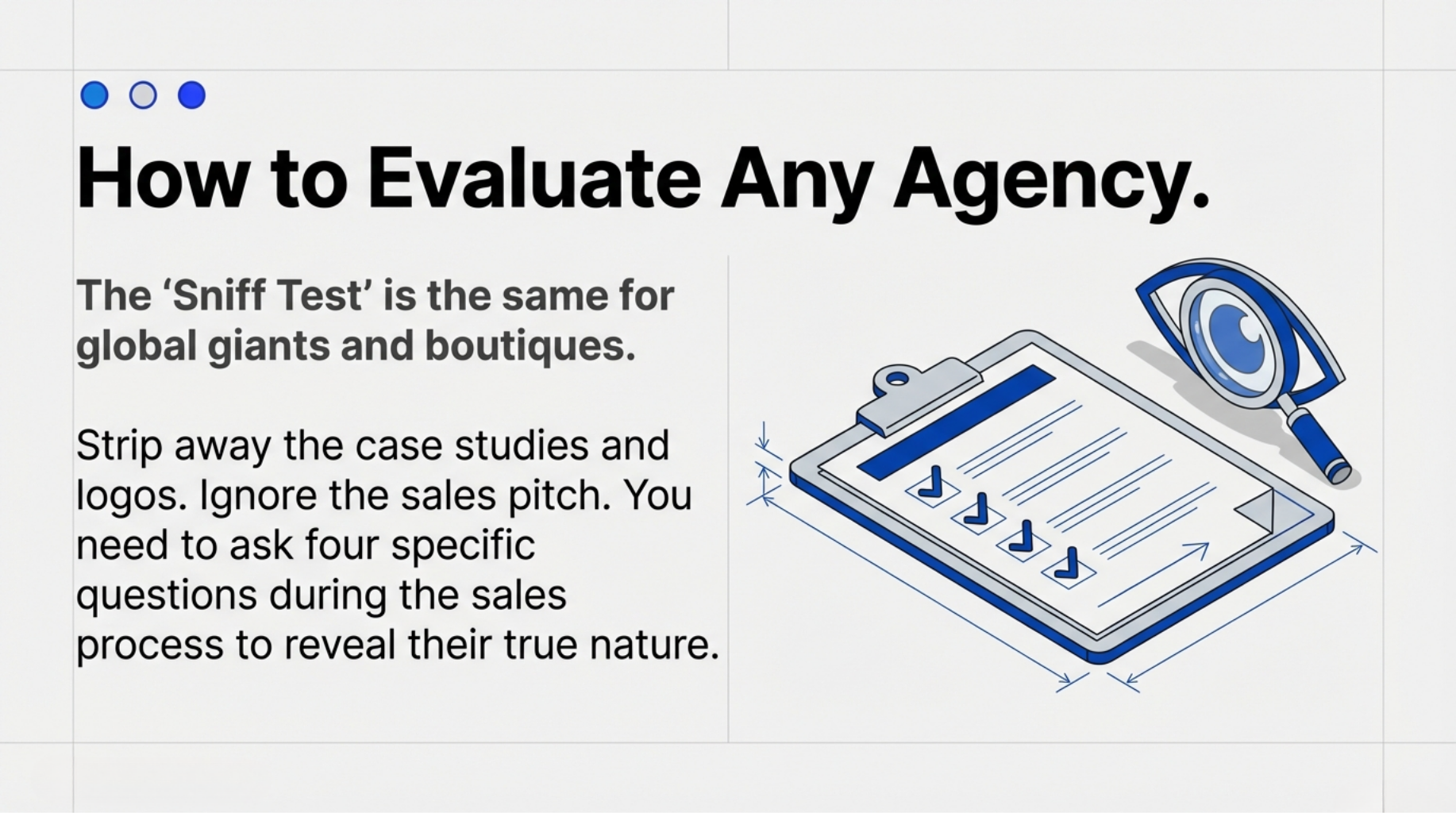
Whether you are looking at a massive global agency or a three-person boutique, the sniff test is exactly the same.
You need to strip away the case studies and the logos on their homepage.
And you need to ask four specific questions during the sales process:
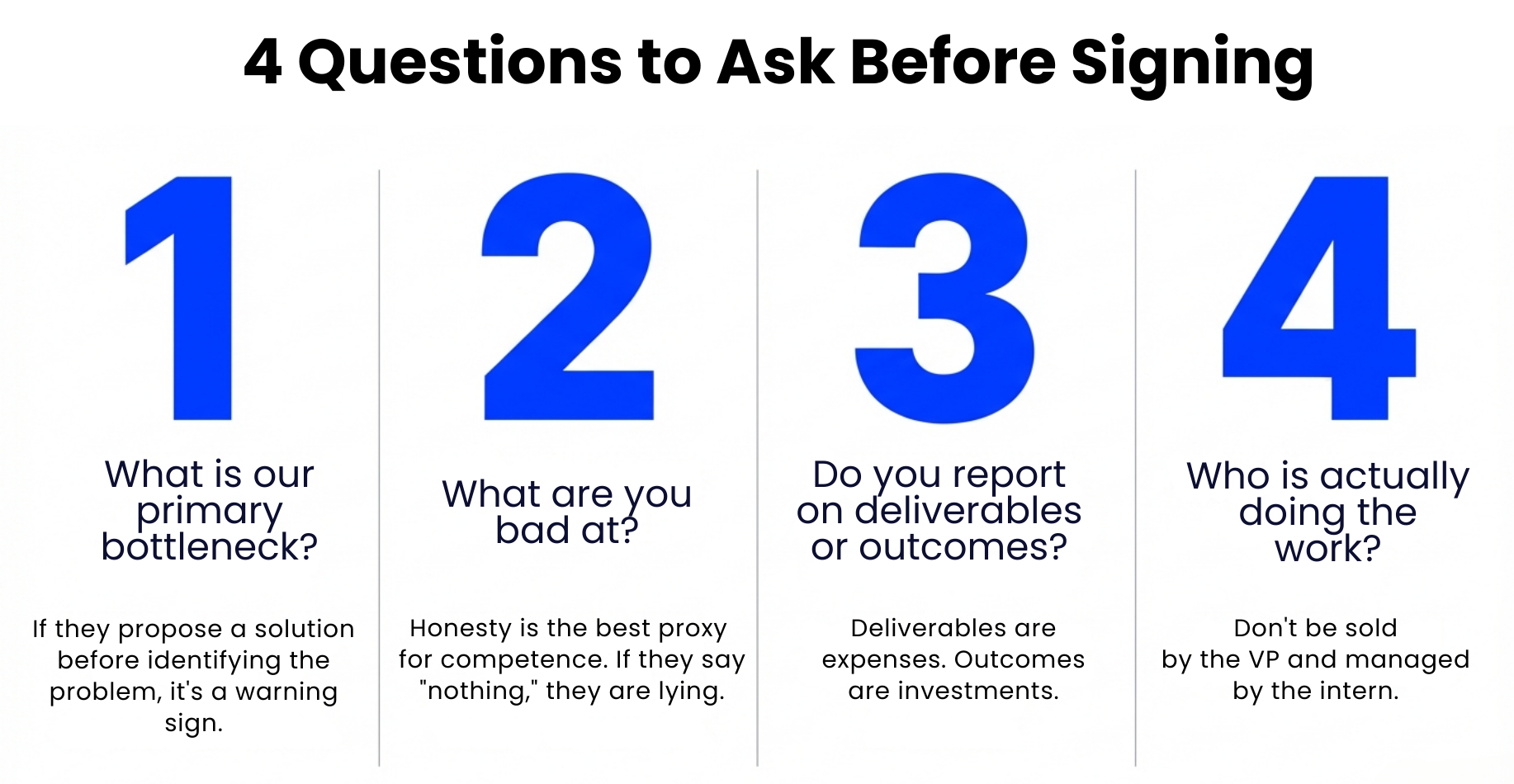
1. “What do you think our primary bottleneck is?”
This question does most of the work for you.
A bad agency will immediately start pitching its solution. They will tell you that you need 20 links a month or 10 blog posts a week before they have even looked at your Search Console data.
This is malpractice. It is like a doctor prescribing surgery before checking your vitals.
A good agency will push back. They might say they need access to your data first. They might ask what you have tried, what has stalled, and where you feel pressure internally.
Sometimes, the most credible answer they’ll give is that they need more information before committing to a plan.
2. “What are you bad at?”
This catches people off guard.
A full-service agency should admit that their PR capabilities are outsourced or that they aren’t experts in complex JavaScript frameworks.
A specialist should admit that they don’t touch code or don’t handle content.
Honesty about limitations is the best proxy for competence. If they claim to be world-class at everything, they are lying.
3. “Do you report on deliverables or outcomes?”
There is a massive difference here.
Deliverables look like this: “We built 10 links.” “We wrote 5,000 words.”
Outcomes look like this: “We improved organic traffic to the /features/ folder by 15%.”
Deliverables are just expenses. Outcomes are investments.
A busy spreadsheet means absolutely nothing if your sales team is starving.
4. “Who is actually doing the work?”
In many agencies, you are sold by the VP of Strategy.
Then you sign the contract and are handed off to a Junior Account Manager who graduated six months ago.
Ask to meet the hands on the keyboard. Ask who will be managing the strategy day-to-day.
If they won’t let you speak to the execution team, you have your answer.
The Final Verdict
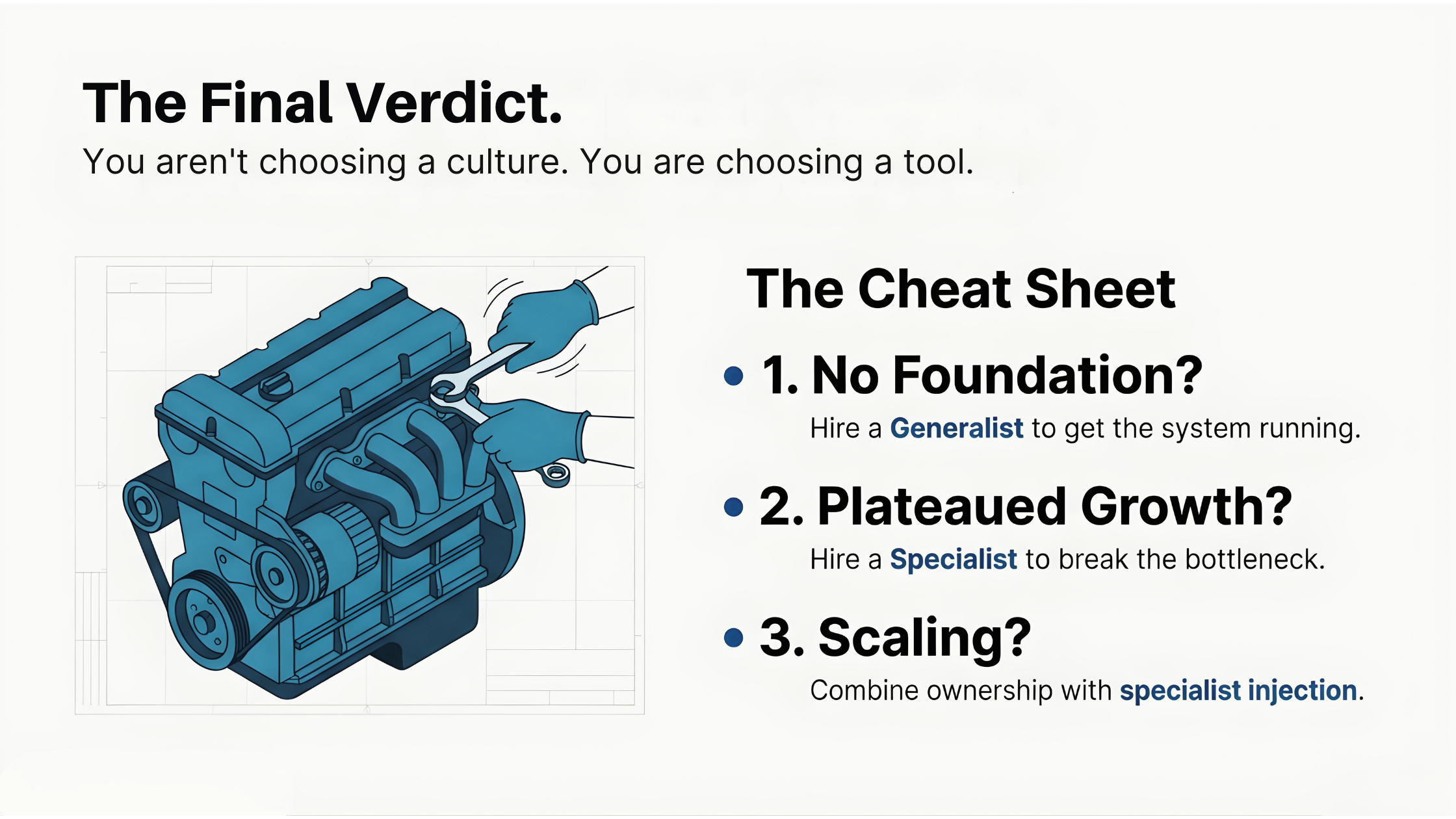
The full-service vs. specialized debate is mostly noise.
If your marketing engine is missing parts, you need coverage. A generalist helps you get the system running: baseline technical hygiene, foundational content, analytics, and steady execution across the board.
If the system is built but growth has stalled, you need depth. A specialist finds the constraint and applies pressure where it counts: the technical bottleneck, the authority gap, the positioning flaw, the pages that should be driving pipeline but aren’t.
Progress does not come from more activity. It comes from pressure applied in the right place.
So the decision is simple:
- No foundation: hire a generalist to build it.
- Plateaued growth: hire a specialist to break the bottleneck.
- Scaling: combine both, with clear ownership and sequencing.
Be clinical about it. Diagnose first. Hire second.
The wrong agency does not just waste budget. It delays the moment your SEO starts compounding.

- Best Blogger Outreach Services in the UK [2026] - August 13, 2026
- Best Reddit Brand Mention Services (Honest Review) - August 5, 2026
- Best B2B SEO Agencies for Pipeline Growth [2026] - October 16, 2026
Get more traffic, get more conversions – all without paying for ads 

Let’s chat to see if we can help you multiply your SEO revenue.
Get more traffic, get more conversions – all without paying for ads
Let’s chat to see if we can help you multiply your SEO revenue.
