
Your board doesn’t care how many keywords you rank for. They care whether organic visibility drives qualified pipeline, shorter sales cycles, and revenue you can attribute.
That’s getting harder as discovery shifts from classic SERPs to AI assistants, answer engines, and zero-click surfaces. You’re still expected to grow organic, but the rules of visibility have changed. Since traditional SEO-only partners will no longer cut it, you need an agency that understands both the old game and the new.
The generative engine optimization (GEO) agencies for SaaS brands below are built for that reality. Instead of simply chasing traffic, they’re aligning SEO, content, and GEO with how modern buyers evaluate products.
The 5 Best GEO Agencies for SaaS Brands
The following five partners offer distinct approaches to turning organic discovery, across search and AI surfaces, into a predictable, defensible revenue channel.
To narrow down the type of partner you actually need, map each one’s unique strengths to your current GTM model, product maturity, and internal capabilities. This helps you look past flashy case studies and focus on actual fit.
1. Growth Partners Media
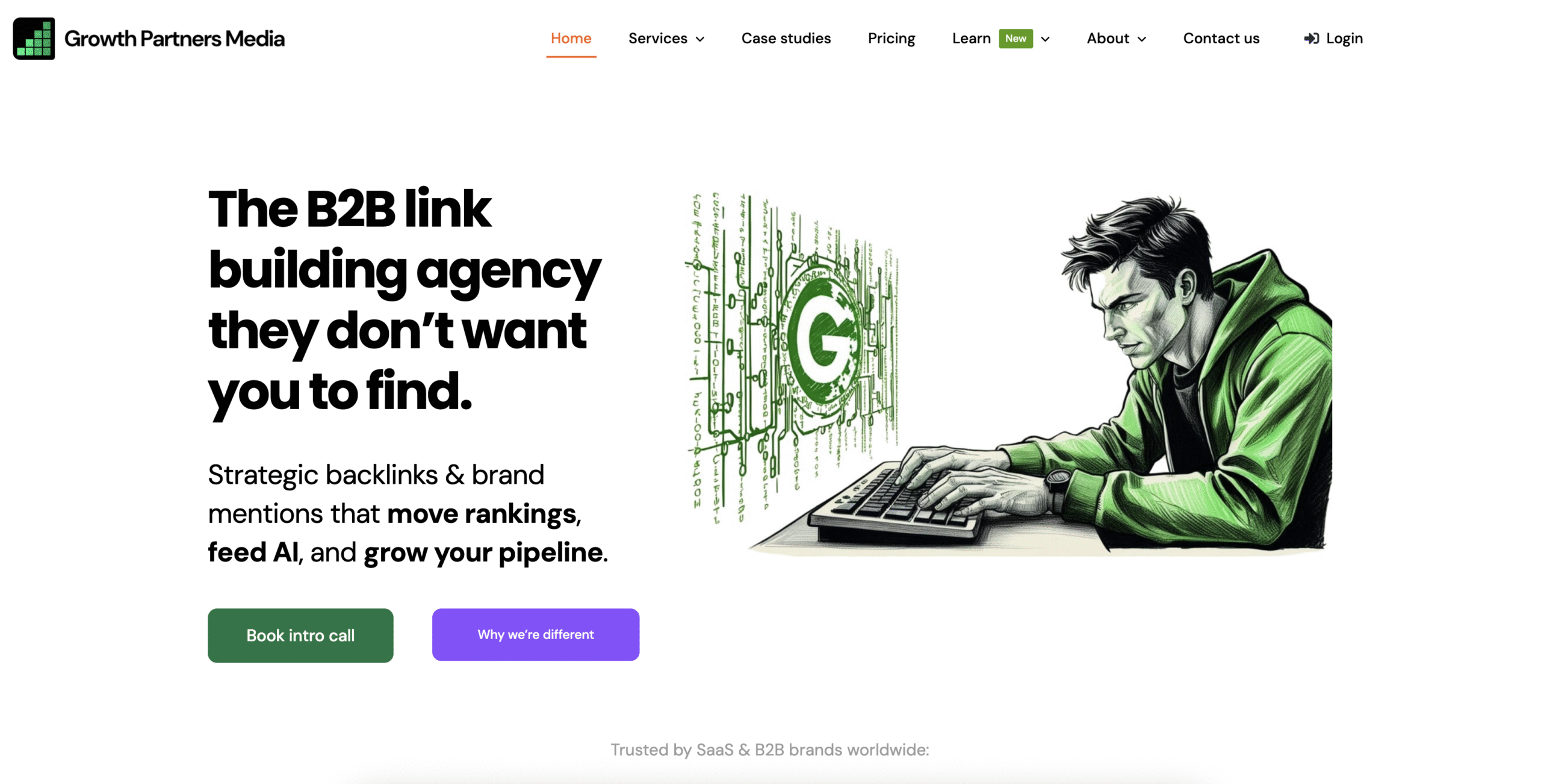
Growth Partners Media focuses on building authority where search and GEO visibility directly influence high-value deals, particularly in international markets.
- Best for: Product-led SaaS expanding into competitive markets that depend on organic discovery for signups and view SEO/GEO as long-term infrastructure
- Notable clients: Growth-stage companies in cybersecurity, IT infrastructure, and enterprise software
- Key services: In-house link acquisition, international SEO, entity SEO, and GEO-informed outreach
- Not ideal for: Early-stage products still validating fit or teams chasing quick fixes
Growth Partners’ approach centers on one core competency: earning authoritative links and mentions that compound domain strength over time. They specialize in competitive categories where buyers spend ample time researching options and where ranking higher translates into meaningful pipeline.
Because the team operates across the UK and Europe, they bring hands-on experience with international SEO and GEO-specific nuances, including regional publishers and country-level authority signals. The agency prioritizes entity SEO, using structured data and citations to strengthen your brand presence, helping Google and LLMs understand your expertise and increasing your odds of appearing in AI-assisted answers.
2. Omniscient Digital
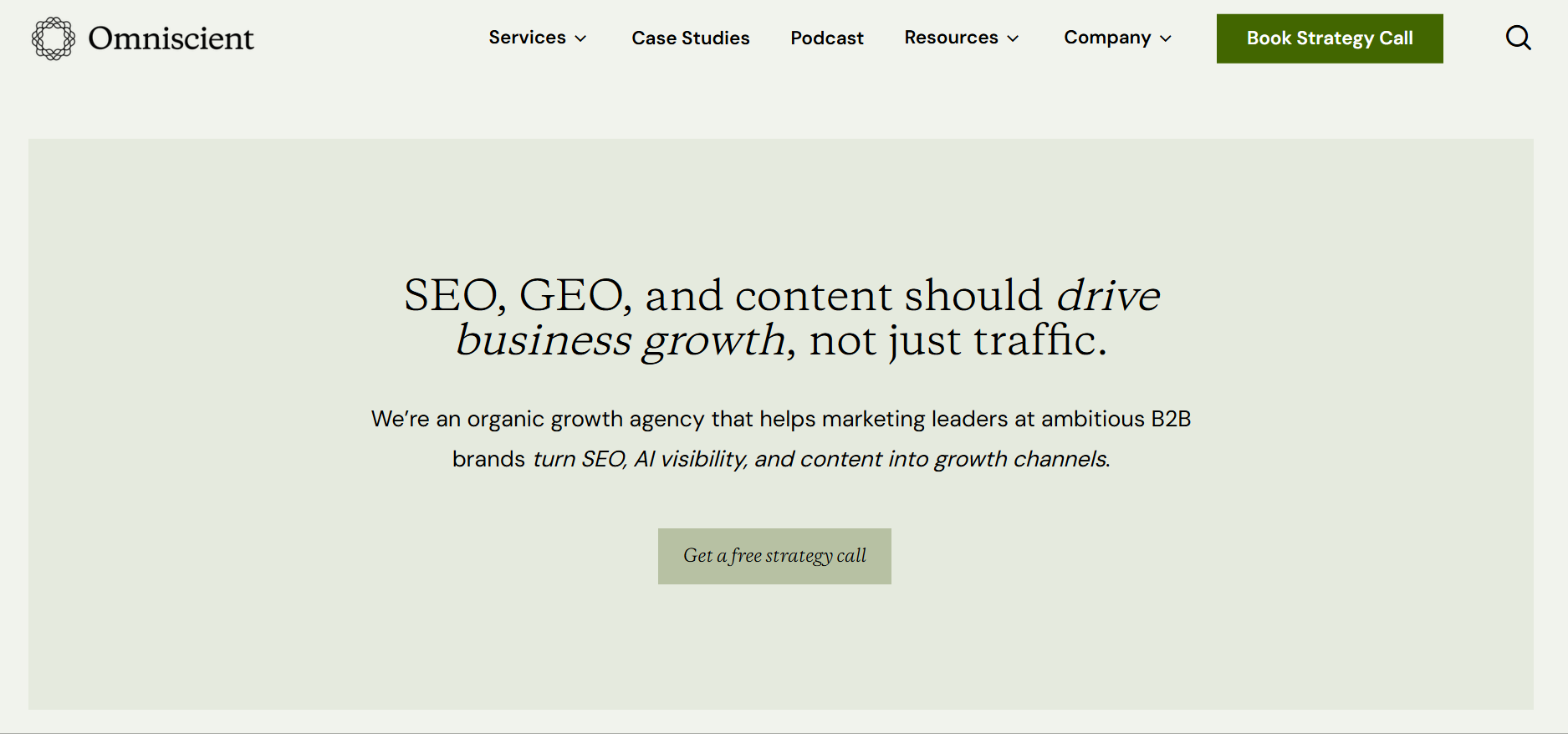
Omniscient Digital serves established SaaS companies that need to prove organic growth directly contributes to pipeline and revenue.
- Best for: B2B SaaS companies $10M+ ARR seeking tight alignment between SEO/GEO, content, and revenue goals
- Notable clients: TikTok, Jasper, Asana, Loom, Hotjar, SAP, and Vendr
- Key services: Buyer research-driven SEO, technical SEO, GEO strategy, product-led roadmaps with full-funnel content production, and digital PR
- Not ideal for: Early-stage SaaS under ~$5M ARR, teams primarily seeking paid ads or social execution, or companies expecting short-term tactical fixes without committing to a multi-quarter compounding strategy
At Omniscient Digital, every engagement starts with OmniscientX, a research process that blends ICP definition, voice-of-customer insight, and competitive analysis. By creating a content and SEO strategy based on how your buyers actually search and evaluate solutions, Omniscient provides a roadmap that connects directly to objections your sales team hears every day.
Their barbell content strategy pairs product-led “money pages” (feature, comparison, and solution pages) with thought leadership and educational assets that build authority across both search engines and generative engines.
They apply GEO tactics like prompt-aware content structures, schema and entity work, and updates to owned properties so your brand is more likely to be cited or summarized when buyers ask AI tools for recommendations.
Omniscient also runs full editorial workflows: strategy, briefs, expert interviews, writing, editing, on-page optimization, and ongoing testing. Digital PR and content promotion sit inside the same system, ensuring authority-building work reinforces the themes and pages that impact pipeline most.
Because leadership held in-house roles at companies like HubSpot, Shopify, Workato, and Backcountry, they treat content as part of revenue operations rather than an isolated marketing output. Their focus on authority-driven organic growth makes them an excellent fit if you want deep channel expertise over a surface-level “do everything” shop.
3. Directive Consulting
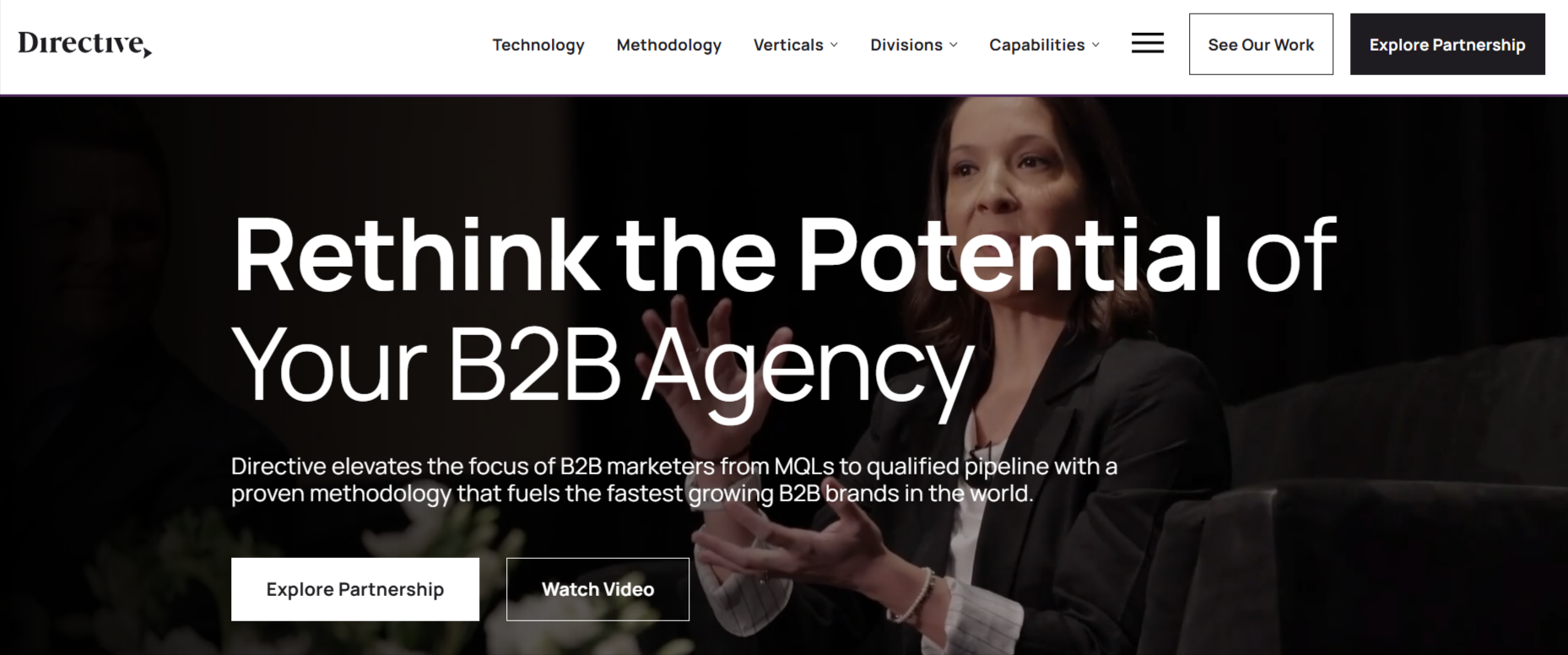
Directive Consulting is a performance marketing agency for B2B SaaS that treats SEO and GEO as part of a broader system for generating a qualified pipeline.
- Best for: Enterprise and growth-stage teams that want full-funnel demand generation tied to revenue and have enough budget to support integrated media and SEO (often $5,000+/month in fees)
- Notable clients: Amazon, Calendly, ZoomInfo, and Snowflake
- Key services: Customer Generation methodology, SEO and answer engine optimization (AEO), paid media, account-based marketing (ABM), and demand gen
- Not ideal for: Very early-stage teams with limited budgets or organizations that only want organic support without any paid or RevOps alignment
Directive’s Customer Generation methodology explicitly rejects MQL vanity metrics, building programs that drive qualified opportunities and closed-won revenue directly visible in your CRM. That’s a crucial distinction if you’re moving away from legacy lead-gen models that optimize for ebook downloads instead of sales outcomes.
The agency integrates SEO, GEO-minded content, paid search, paid social, ABM, and CRO under one strategy. For SaaS brands selling into named accounts or defined ICP segments, they use intent data and account-level targeting to focus efforts on the companies that sales teams actually want to talk to.
Directive invests heavily in experimentation and financial modeling. Before rolling out new tactics broadly, they test them against real numbers—CAC, LTV, payback period—so recommendations are grounded in economic reality. Their retention and review profiles reflect a focus on long-term engagements rather than short, campaign-only work.
4. Siege Media
Siege Media is a content-led SEO agency that aims to create assets that drive measurable business value for B2B SaaS, especially in categories where content saturation is high.
- Best for: SaaS brands with established product-market fit that prioritize strategic, high-quality content and long-term compounding
- Notable clients: Asana, HubSpot, Zendesk, Zapier, Figma, and Zoom
- Key services: SEO strategy, Keyword Opposition to Benefit (KOB) analysis, content production, digital PR, link building, and GEO-conscious optimization
- Not ideal for: Early-stage or budget-constrained teams that need low-cost, high-volume content or short-term paid acquisition
Siege starts with KOB analysis, a framework that weighs search demand against ranking difficulty and business value. Instead of publishing in every topic cluster, they prioritize opportunities where you can realistically win and where ranking actually contributes to demos, signups, or influenced opportunities.
Their team produces a mix of assets—long-form guides, tools, calculators, interactive content, and data studies—designed to earn links and attention while addressing bottom- and mid-funnel intent. They’ve shipped tens of thousands of pieces over more than a decade, giving them a deep pattern library for what often works in crowded categories.
Digital PR is fully integrated into execution. Siege doesn’t just hit publish and hope; they actively promote high-value pieces to relevant media and industry sites to earn backlinks and citations. This supports both classic SEO and GEO, as these references are the authority signals AI systems use to surface sources in AI-assisted results.
Since the agency positions itself as a premium partner, pricing is custom and based on projected content ROI and volume rather than off-the-shelf packages.
5. Animalz
Animalz is an editorially driven content agency for B2B SaaS brands that want to build category authority across search, AEO, and GEO-influenced discovery.
- Best for: Enterprise and later-stage B2B SaaS with budgets ($10,000+/month) for opinionated, research-backed content
- Notable clients: Google, Intercom, GoDaddy, Zendesk, Amazon, Asana, and QuickBooks
- Key services: SEO and AEO strategy, long-form editorial content, original research, content refresh programs, technical audits, and authority-focused outreach
- Not ideal for: Very early-stage products, teams prioritizing content quantity over depth, or organizations looking for a multi-channel agency for paid acquisition
Animalz centers its work on “The Animalz Way,” an approach that prioritizes subject-matter expertise and original thinking. Instead of chasing every keyword variation, they focus on arguments that shape how your market thinks and buys.
The Animalz team builds content systems that perform in both traditional SERPs and AI-assisted environments. This includes optimizing for answer engines, refining site structure around entities and topics, and ensuring your best content is easy for both humans and machines to reference.
By working closely with your internal experts—founders, PMMs, sales leaders—they capture credible, differentiated perspectives, making their work particularly effective in complex or emerging categories.
Note that Animalz is selective about volume. If you want daily posts, they’re probably not the right fit. If you’re after a smaller set of high-impact pieces that support sales, product marketing, and brand positioning, their model aligns much better.
How to Choose the Right Agency
Choosing the wrong GEO or SEO partner does more than waste budget. It can set your organic motion back by months or years. The right agency helps prove that organic is a revenue engine, and the wrong one floods you with traffic and leads your sales team can’t close.
As you evaluate GEO agencies for your SaaS brand, ground your decision in four angles: how they measure success, how well they understand SaaS economics, how they think about AI-era discovery, and how they integrate with sales and customer success.
Revenue attribution and measurement philosophy
If an agency’s reporting focuses on sessions and rankings, you’ll likely repeat the same board conversation you’ve already had: “Nice charts. Where’s the revenue?” Measurement philosophy sets the direction for every tactic that follows.
A strategic partner anchors success in revenue-adjacent metrics, including influenced and sourced pipeline, opportunities touched by organic content, and improvements in win rate for accounts engaging with specific assets. They still track rankings and traffic, but as leading indicators instead of success endpoints.
They’re also honest about attribution limits. Multi-touch models tend to create an illusion of precision by sprinkling fractional credit everywhere. Strong agencies balance that with directional insight, identifying which topics and pages appear most often in successful deals and how organic influences opportunities that start in paid or outbound channels.
The signal to look for in sales conversations is simple. If they ask detailed questions about your CRM, sales cycle, average contract value, and conversion rates before discussing traffic goals, it shows they’re building a framework tied to actual economics.
Industry expertise and SaaS-specific experience
SaaS buying cycles don’t look anything like consumer purchases. Multi-stakeholder committees, technical evaluations, security reviews, and long-term ROI questions are standard parts of the deal, and the agency must understand how that reality shapes content and SEO.
For example, they should be clear on how product-led growth (PLG) motions change the role of organic, how freemium and trials affect keyword targeting, and why finance, IT, and end users require different messaging for the same feature set.
This depth shows up in a few ways: a team’s past in-house roles at software companies, case studies that clearly describe MRR impact or sales outcomes, or content examples that speak to evaluators at different levels of sophistication. Generic “B2B experience” falls short when product complexity is high, and ACV is meaningful.
Prospective partners should also be able to articulate how they handle specific scenarios, such as category creation vs. displacement, PLG vs. sales-led motions, or moving upmarket into enterprise. Their insights reveal whether they truly understand SaaS dynamics or are simply repackaging generic content marketing advice.
Approach to AI-Era discovery and GEO
Search is no longer just ten blue links. Your buyers are asking ChatGPT, Perplexity, and AI Overviews for shortlists, comparisons, and best practices before they ever reach your site.
An agency prepared for this environment has a clear GEO point of view. They talk about entities and topics, not just keywords. They show how they structure content so it’s easier for LLMs to interpret and reference. They incorporate digital PR and citation strategies that increase your chances of being mentioned in AI-generated answers.
They’re also realistic about measurement. GEO impact is harder to track than click-based search behavior. Sophisticated partners monitor directional indicators like brand search volume, referral patterns from AI-native tools, and the presence of your brand or content in AI responses during manual checks.
If a potential partner treats GEO as a throwaway add-on to “traditional SEO services,” assume they’re behind. The right partner builds for AI-native discovery from day one.
Integration with sales and customer success teams
Organic performance doesn’t live in Google Analytics. It shows up in your pipeline, win rates, and expansion revenue. But that only happens if your agency works closely with sales and customer success.
Effective partners want to listen to sales calls, review win/loss analyses, and understand your renewal and expansion motions. They use that intelligence to prioritize topics, shape content angles, and decide which assets to build for each deal stage.
On the operations side, your agency should be comfortable feeding organic engagement data into your CRM and account scoring models. That way, sales can see which accounts consume high-intent content, and CS can identify customers signaling expansion opportunities or churn risks through their search behavior.
If an agency only wants access to your marketing automation platform and never asks to speak with sales or CS, expect a gap between what they produce and what your revenue teams actually need.
Building a Successful Partnership With Your SaaS Agency
The agency you choose is essentially joining your growth team. The quality of that partnership determines whether organic becomes a core revenue channel or another experiment leadership loses patience with.
Start by aligning on measurement before you agree on tactics. Give your agency access to the same revenue dashboards your executive team reviews and a clear understanding of how you define marketing-sourced and influenced pipeline. That shared view keeps everyone honest as results start to compound or when early assumptions need to change.
Next, define communication rhythms that avoid the “black box” problem. Weekly or biweekly working sessions—plus quarterly business reviews tied to pipeline, deal size, and CAC—keep the relationship grounded in outcomes instead of activity. You should always know not just what’s being worked on, but why it matters for your revenue model.
Finally, treat the first 60–90 days as a discovery and foundation period rather than a rushed performance window. A partner that pushes to launch content in week one without deep buyer research, technical audits, and sales coordination is optimizing for optics, not durability. Agencies do their best work when they have space to build a real strategy before stepping on the gas.
Ultimately, the information in this guide should help you choose a partner that treats organic not as a traffic channel, but as a core growth engine. When you find an agency that understands SaaS economics and the shift toward AI-era discovery, organic becomes a system for compounding revenue for years to come.

- Best Blogger Outreach Services in the UK [2026] - August 13, 2026
- Best Reddit Brand Mention Services (Honest Review) - August 5, 2026
- Best B2B SEO Agencies for Pipeline Growth [2026] - October 16, 2026
Get more traffic, get more conversions – all without paying for ads 

Let’s chat to see if we can help you multiply your SEO revenue.
Get more traffic, get more conversions – all without paying for ads
Let’s chat to see if we can help you multiply your SEO revenue.
